
Are Oracle Dependencies an Underpriced Risk in On-Chain Markets?
Understand how oracle dependencies create hidden risks across DeFi lending and perpetual markets as billions rely on accurate external prices


On-chain finance often measures decentralization through custody, governance, and permissionless execution. However, another dependency sits beneath many protocols: they rely on external systems to determine what assets are worth.
Lending markets depend on external prices to value collateral and trigger liquidations. Perpetual exchanges need reference prices for margin, profits, losses, and settlement. If those prices become stale, fail, or are manipulated, decentralized execution cannot prevent the resulting economic consequences.
Lending Turns Prices Into Credit Decisions
A lending protocol cannot independently determine whether deposited ETH is worth $2,000 or $4,000. Its contracts rely on oracle infrastructure for that information. According to Aave, that price determines borrowing capacity and helps establish when collateral becomes eligible for liquidation. The exposure is already substantial.
Aave currently holds about $19 billion in total value locked. That makes accurate collateral pricing central to a lending system managing billions in user capital. Normal liquidations demonstrate how closely lending markets depend on prices. But the more important question is what happens when the price itself becomes unreliable. An overstated collateral value could allow excessive borrowing. An understated value could push otherwise healthy positions toward liquidation.
According to a governance update, Aave confirms that a delayed price could leave contracts responding to market conditions that no longer exist. In each case, the smart contract could perform exactly as designed and still generate the wrong economic result. That is why oracle risk should be considered alongside collateral and liquidation risk rather than treated as background infrastructure.
Perpetual Markets Increase the Exposure
Leveraged markets make that dependency even clearer. DeFiLlama currently tracks about $14.2 billion in open interest across decentralized derivatives platforms. Hyperliquid accounts for $8.1 billion, 57% of the total.
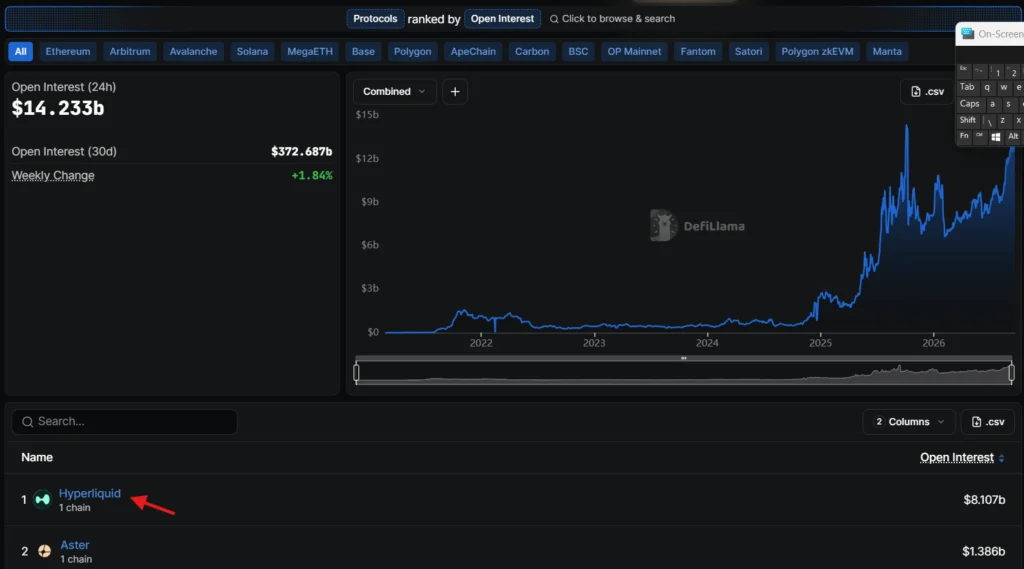
Source: DefiLlama
That open interest represents positions whose values continue changing with market prices. Reference prices can influence profit and loss, margin requirements, and liquidation thresholds. An incorrect price therefore does more than give traders bad information. It can determine whether leveraged positions survive.
The amount of capital whose valuation depends on an oracle can be far larger than the infrastructure producing the price. As perpetual open interest expands, the potential consequences of an incorrect reference price can grow with the amount of capital and leverage linked to that price.
Decentralization Can Hide Concentrated Dependencies
Oracle concentration adds another dimension. DefiLlama shows Chainlink securing about $39.1 billion across more than 533 protocols. Internal oracle systems account for $8.1 billion, followed by Chronicle, RedStone, and Pyth.
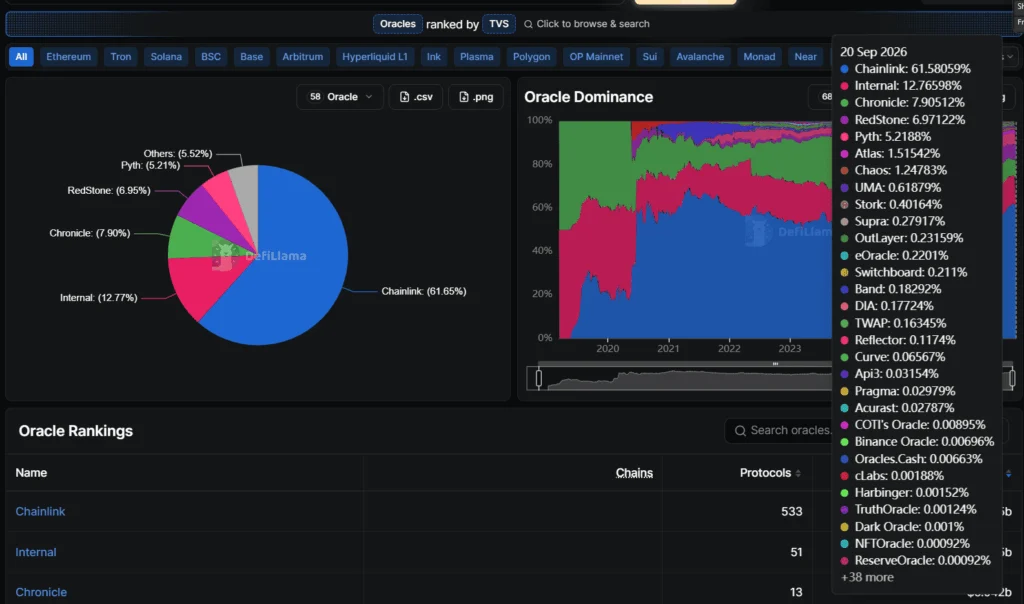
Source: DefiLlama
Those figures do not mean that billions would automatically be lost if one feed failed. They are measures of the capital or value covered by the tracked oracle infrastructure, not direct estimates of losses from an outage or manipulation. However, they show how much on-chain activity can rely on a relatively small group of pricing architectures. That matters when judging decentralization and dependency.
A protocol can decentralize governance and execution while still depending heavily on one pricing mechanism. As shown by Chainlink’s market and data feed infrastructure, if that mechanism determines collateral values, liquidations, or settlement, it becomes an economic dependency even if the surrounding contracts remain decentralized.
Oracle Risk Should Reflect Capital at Stake
This is where current risk analysis can be expanded. The important question should not simply be whether an oracle can fail. Markets should also ask how much capital depends on that oracle remaining accurate.
A feed influencing $5 million in collateral carries a different economic consequence from one supporting billions in loans or leveraged positions. Oracle analysis should therefore include market liquidity, collateral exposure, outstanding debt, open interest, update reliability, and fallback mechanisms. This framework better reflects how modern on-chain markets operate.
Oracle dependency deserves to be treated as part of a protocol’s financial risk, not merely its technical architecture. The vulnerability is not simply that decentralized markets need external prices. It is that substantial amounts of capital can depend on those prices remaining accurate, including during periods when market conditions are changing rapidly and the consequences of an inaccurate reference price can become more severe.
Victor Muriki
My name is Victor Muriki, and I’m a blockchain, Web3, and market news writer with more than five years of experience covering the crypto and fintech industries.
More from Victor Muriki →This article is for information only and is not investment advice. We report under our Editorial Policy; to flag an error, see our Corrections Policy.