Will DTCC’s Tokenization Service and Morgan Stanley’s Early Move Finally Force Wall Street’s Full Crypto Embrace?
DTCC and Morgan Stanley bring tokenization to Wall Street, but will blockchain lower costs for investors or strengthen financial intermediaries?


Wall Street has begun using infrastructure that allows U.S. equities and Treasury securities to be represented as tokens. The Depository Trust & Clearing Corporation (DTCC) launched its new tokenization service, with Morgan Stanley among the first institutions to use it.
DTCC operates essential infrastructure for securities custody, clearing, and settlement in the United States. Its subsidiary, the Depository Trust Company (DTC), holds assets worth more than $114 trillion in custody.
However, bringing blockchain technology to Wall Street does not necessarily mean transforming how the financial system operates. The technology can accelerate certain transactions without changing who controls the assets, authorizes transactions, or charges for services.
The question is whether tokenization will eliminate unnecessary costs and procedures or simply add another technological layer to a market that already depends on numerous intermediaries.
DTCC: Turning Tokenization Into Real Transactions
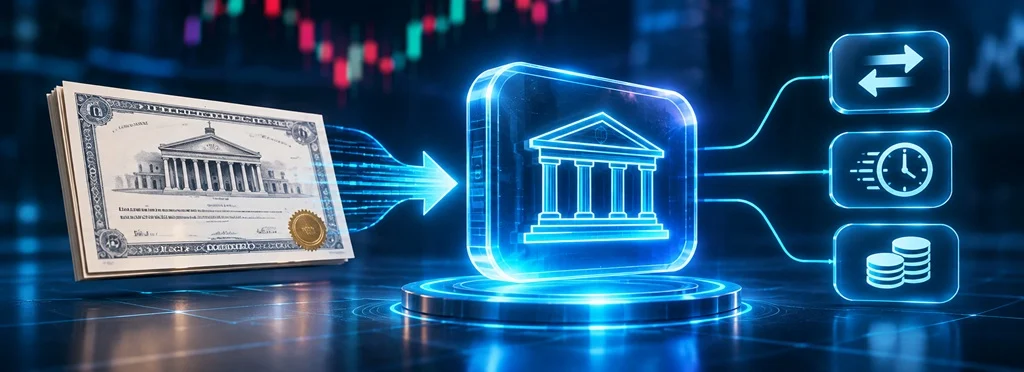
According to DTCC’s official announcement, the service went live on October 28 and allows digital representations of securities that remain in DTC custody to be created.
Authorized clients can convert certain assets between their traditional and tokenized forms. The tokenized versions retain the ownership rights, legal protections, and economic benefits associated with the original securities.
So far, 20 institutions have signed agreements to access the service, including Morgan Stanley, JPMorgan, Bank of America, Citi, Barclays, Fidelity, and UBS.
Morgan Stanley is among the first banks to use this infrastructure to work with tokenized representations of U.S. equities and Treasury securities.
The participation of these institutions carries more weight than the launch of another experimental project. DTCC has already processed real transactions involving tokenized assets, including securities lending, equity transfers, and Treasury-related transactions.
The service currently operates on Canton Network and a private Besu-based network. DTCC also plans to integrate additional blockchain networks during 2027.
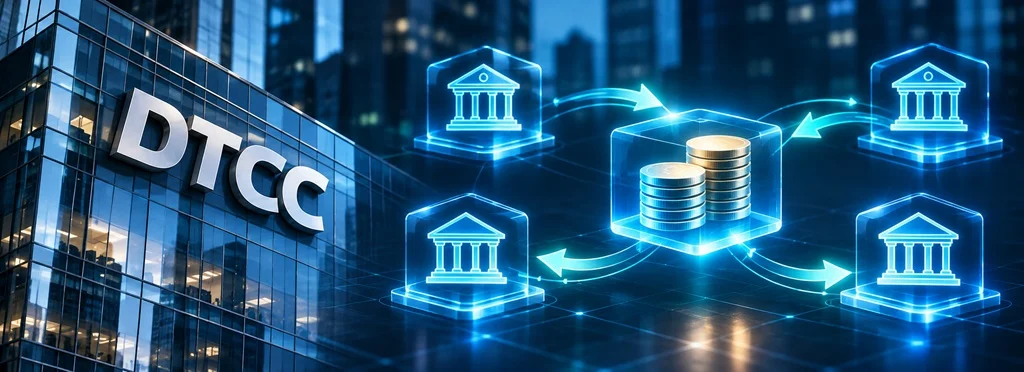
This infrastructure could facilitate collateral transfers between institutions and reduce the time required to mobilize assets used in financial transactions.
For example, an institution that needs to post Treasury securities as collateral could transfer their tokenized representation without relying on every traditional transfer and reconciliation procedure.
The ability to mobilize collateral within minutes has economic value, particularly for institutions managing large portfolios that need to use their capital efficiently.
However, these technical advantages still need to translate into lower operating costs and measurable improvements for participants.
Wall Street Adopts Blockchain Without Giving Up Control
DTCC’s model also helps identify the limits of this transformation.
The original securities remain in DTC custody, while tokens represent the rights associated with those assets. Institutions must meet participation requirements and use registered wallets.
This means the infrastructure maintains centralized controls over the issuance, conversion, and administration of tokenized securities.
The U.S. Securities and Exchange Commission (SEC) authorized the service through a no-action letter issued in December 2025. The authorization establishes conditions and initially covers certain equities, exchange-traded funds, and Treasury securities.
Tokenization also does not automatically eliminate legal issues involving ownership, custody, or settlement. Institutions still need to coordinate their traditional records with transactions conducted on blockchain networks.
DTCC will therefore need to demonstrate that it can maintain that coordination as trading volumes increase and more institutions participate.
There is also a risk that individual institutions will develop solutions operating on different networks. If tokenized assets cannot move easily between platforms, fragmentation could undermine some of the promised benefits.
What About the Benefits for Investors?
The interest shown by Morgan Stanley and other banks confirms that blockchain can be integrated into traditional financial operations. But it does not prove that end users will benefit from lower fees or greater market access.
Institutional adoption can improve efficiency without reducing the power of intermediaries. It could even strengthen the institutions that already manage securities custody and clearing.
That is why DTCC’s success should be measured by concrete results: lower costs, faster transfers, greater collateral availability, and fewer administrative procedures.
Wall Street has already begun using tokenized assets in real transactions. The question is how much of that efficiency will reach investors and how much will remain within the institutions controlling the new infrastructure.
Tyler Anderson
Hi there! I'm Tyler Anderson from Sweden, and I'm a Web3 Reporter. My main focus is exploring the evolution of Web3, from DAO governance to the real utility of decentralized protocols.
More from Tyler Anderson →This article is for information only and is not investment advice. We report under our Editorial Policy; to flag an error, see our Corrections Policy.