Will Persistent ETF Outflows Signal the End of the Institutional Crypto Era?
Bitcoin and Ethereum ETF outflows raise doubts about institutional crypto demand, but do recent withdrawals signal a lasting retreat?


Bitcoin and Ethereum ETFs are experiencing capital outflows that are testing confidence in institutional cryptocurrency adoption. US Bitcoin funds lost $1.0418 billion in just two trading sessions, while Ethereum products recorded six consecutive sessions of withdrawals.
The wave of outflows is a direct response to the market downturn and the consequences of the recent Binance hack. Bitcoin plunged to nearly $76,300. Investors are now trying to determine whether the current selling pressure represents a temporary correction or the beginning of a more prolonged retreat.
This situation calls into question an idea that has dominated the market for years: institutional participation does not guarantee permanent demand for cryptocurrencies. Large investors also sell when uncertainty increases, and their decisions can deepen bearish trends.
ETFs Record Heavy Capital Outflows
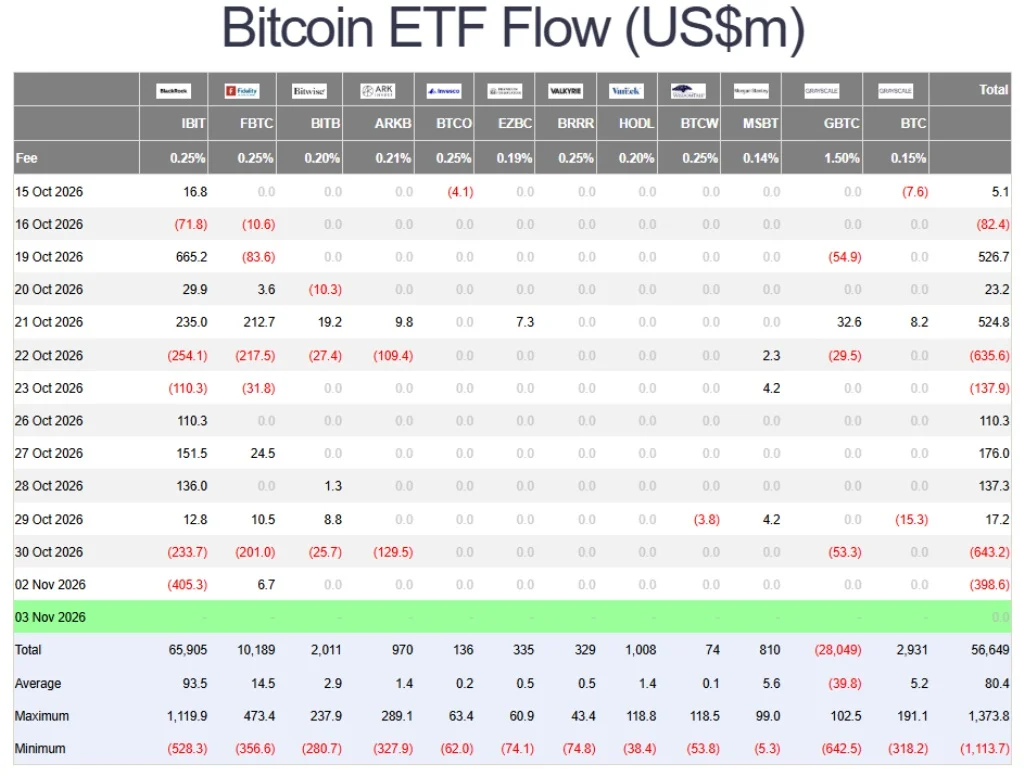
According to Farside Investors data, US Bitcoin ETFs recorded $643.2 million in net outflows on October 30, followed by another $398.6 million on November 2.
BlackRock’s IBIT led withdrawals during the latest session, with $405.3 million leaving the fund. Fidelity, meanwhile, attracted $6.7 million into its FBTC product.
This distinction is important because it shows that fund flows are not uniform. Some funds continue attracting capital even when the broader market experiences net outflows.
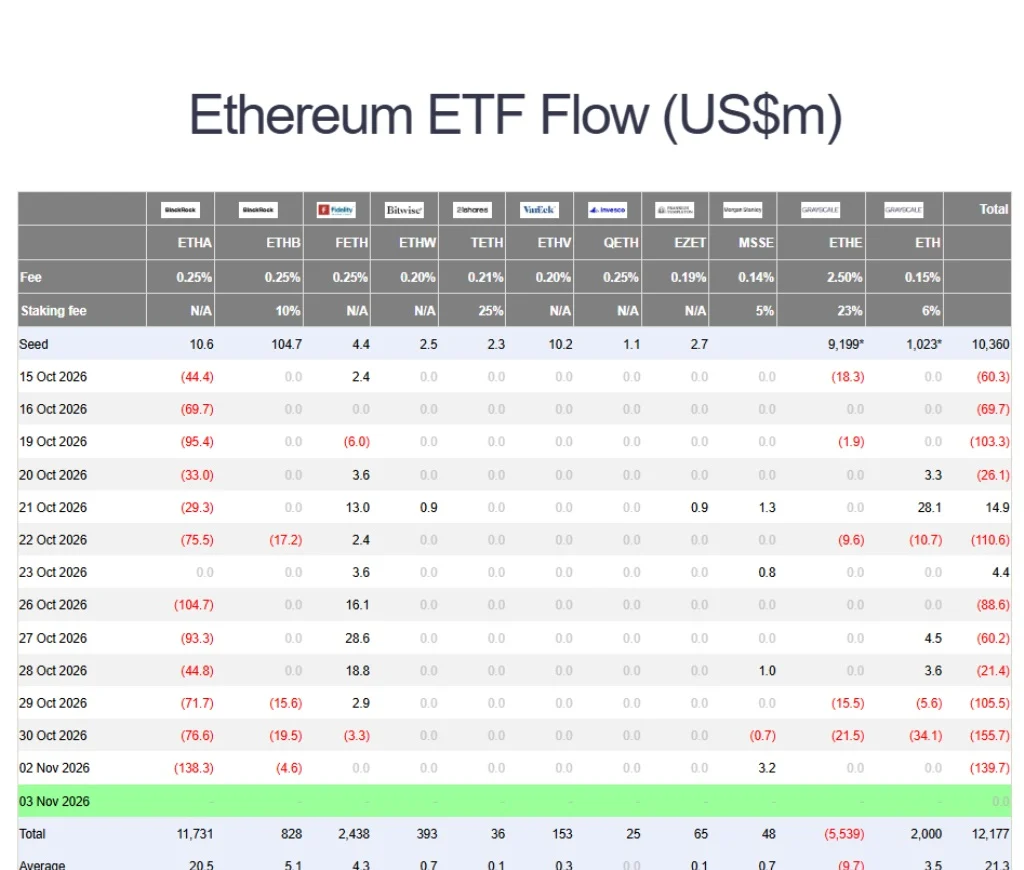
Ethereum is showing signs of a more sustained trend. Its spot ETFs recorded six consecutive sessions of outflows, totaling approximately $571.1 million. On November 2 alone, they lost $139.7 million, primarily due to withdrawals from BlackRock’s ETHA fund.
These figures give investors legitimate reasons for concern. The products that facilitated the entry of traditional capital now also provide a convenient way to reduce exposure.
However, ETF outflows do not prove that all institutions are abandoning cryptocurrencies. The data track net fund subscriptions and redemptions, but they do not independently identify every buyer and seller or explain their motivations.
The Market Can No Longer Depend on Institutional Demand
For years, ETF approval was presented as a decisive transformation for Bitcoin. The argument was straightforward: making cryptocurrencies more accessible to traditional investors would attract capital that previously faced numerous obstacles to entering the market.
That advantage still exists. But it works both ways. The same instruments that allow investors to gain exposure without managing private wallets also make it easier to sell their positions when market conditions change.
Bitcoin fell to approximately $76,300 before recovering partially and is now trading around $77,600. Reports also indicated $4.72 billion in net withdrawals by Binance customers since the exchange reopened.
Both developments indicate pressure across different parts of the market, although they do not establish that ETF redemptions were caused by the hack.
The problem for those expecting an immediate recovery is that institutional participation does not eliminate volatility. Funds may reduce their positions because of liquidity needs, risk management considerations, or portfolio adjustments, without necessarily losing interest in Bitcoin permanently.
There is also insufficient evidence to claim that retail investors are consistently buying while institutions are selling.
Outflows Do Not Mean the End of the Institutional Era
Bitcoin ETFs still have approximately $56.649 billion in cumulative net inflows since their launch, according to Farside Investors. Ethereum products have also maintained a positive cumulative balance of around $12.177 billion.
These amounts do not guarantee future purchases, but they make it unreasonable to equate two negative trading sessions with the dismantling of institutional participation in the crypto industry.
It is also worth examining what happened before the latest withdrawals. Between October 26 and 29, Bitcoin ETFs attracted approximately $440.8 million in net inflows. A single session of redemptions wiped out those gains.
The volatility of fund flows shows that demand can change rapidly. It does not establish that institutional capital has decided to leave the market permanently.
The biggest mistake would be treating institutional adoption as a guarantee of stability. ETFs improved access to Bitcoin and Ethereum, but they also connected these assets to investors who can adjust their positions as their financial needs change.
The institutional era is not over. What is fading is the expectation that major financial firms will continue buying cryptocurrencies regardless of prices and risks.
Colin Harris
I'm Colin Harris, L1s Analyst and Web3 Reporter for the United States. My day-to-day involves diving into the fundamental layers of the ecosystem, specializing in Layer 1 (L1s) networks.
More from Colin Harris →This article is for information only and is not investment advice. We report under our Editorial Policy; to flag an error, see our Corrections Policy.