Will Autonomous AI Agents Finally Make DeFi Usable—or Dangerously Uncontrollable?
Ai Agents could simplify DeFi investing and payments, but weak safeguards may expose users to hacks, losses, and risky automation.


Decentralized finance has promised more accessible financial services for years, but using them still requires knowledge that many users do not have. Managing wallets, comparing yields, moving funds between protocols, and assessing risks are tasks that hinder adoption. Artificial intelligence agents could remove many of these barriers through systems capable of executing transactions on behalf of users.
Automation could make DeFi much easier to use, but it could also turn individual mistakes into losses that are difficult to contain. The difference will depend on the permissions these systems receive and the mechanisms available to stop them.
Giving artificial intelligence autonomy without establishing verifiable limits would place too much responsibility on technology that can still make mistakes.
AI Agents Are Starting to Manage Real Money
Autonomous systems are moving beyond answering questions to executing financial instructions. They can analyze positions, rebalance portfolios, identify yield opportunities, and make payments without requiring human approval for every transaction.
The infrastructure already exists. Coinbase developed x402, a protocol that enables payments through web requests, while Amazon Web Services introduced tools alongside Coinbase and Stripe to facilitate transactions executed by artificial intelligence.
In DeFi, this capability could be particularly useful. Users could specify how much capital they want to invest, which risks they are willing to accept, and when they need to withdraw their funds. The system would then identify protocols that meet those conditions and execute authorized transactions.
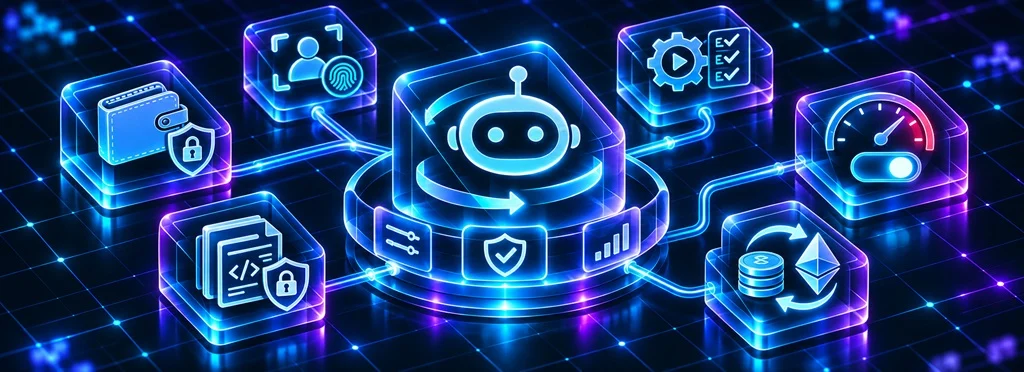
The benefits could be substantial for users who currently rely on complicated interfaces or must constantly monitor their investments. Automation would allow them to access financial strategies without understanding every technical procedure, although they would still need to understand the risks associated with their chosen products.
However, results remain mixed. An analysis by DWF Labs found that automated agents can outperform human traders in specific tasks, such as yield optimization, but struggle more with trading strategies that require evaluating multiple variables.
Autonomy Also Multiplies the Risks
The main problem arises when an agent is authorized to move funds and makes the wrong decision. An incorrect recommendation can be ignored; an automatically executed transaction can cause losses before the user even discovers the mistake.
Risks include vulnerable smart contracts, manipulated information, and strategies that respond similarly to the same market conditions. If numerous systems sell assets simultaneously, their activity could worsen liquidity problems in certain protocols.
There is also the possibility of attacks designed to manipulate an AI system’s instructions. A report from Google Research examined vulnerabilities in autonomous systems involving malicious external content, insecure tools, and manipulation of stored information.
These threats take on another dimension when software controls money. An attacker does not need to compromise a blockchain directly if they can persuade an authorized system to execute harmful transactions.
Liability also remains unresolved. If an AI agent transfers funds to a fraudulent smart contract, it is necessary to determine which responsibilities fall on the developer, the service provider, and the wallet owner.

The DeFi Sector Needs Safeguards Before Delegating Financial Decisions
The solution is not to prevent automation, but to limit what each system can do and how much money it can put at risk.
The ERC-8004 standard establishes mechanisms to identify autonomous systems and record information about their reputation and validation. These tools can make it easier to select trustworthy services, although a verifiable identity does not guarantee safe behavior.
Spending limits, temporary authorizations, restrictions on accessible smart contracts, and automatic shutdown mechanisms should also be required. If a strategy exceeds a loss threshold or begins executing unusual transactions, the agent should stop without waiting for manual intervention.
Payments need equally precise rules. Settlement protocols must make it possible to verify who authorized a transaction, what conditions were established, and how far the granted permission extended.
The DeFi sector will become more accessible when people can delegate tasks without losing control of their funds. AI agents can improve portfolio management and simplify operations that currently require extensive technical knowledge. But an industry still dealing with attacks on smart contracts should not grant unlimited access to capital simply because software is now capable of managing it.
The real test will be building an agent that can execute hundreds of authorized transactions while remaining incapable of carrying out even one that exceeds the limits set by its owner.
Mia Thompson
I am Mia Thompson, a Blockchain Reporter specializing in Altcoins, and I am from Mexico. My day-to-day work consists of exploring the ecosystem beyond Bitcoin.
More from Mia Thompson →This article is for information only and is not investment advice. We report under our Editorial Policy; to flag an error, see our Corrections Policy.