Will Getting Paid in USDC Finally Normalize Crypto as Everyday Money?
Getting paid in USDC could accelerate everyday crypto adoption while raising concerns about financial centralization.

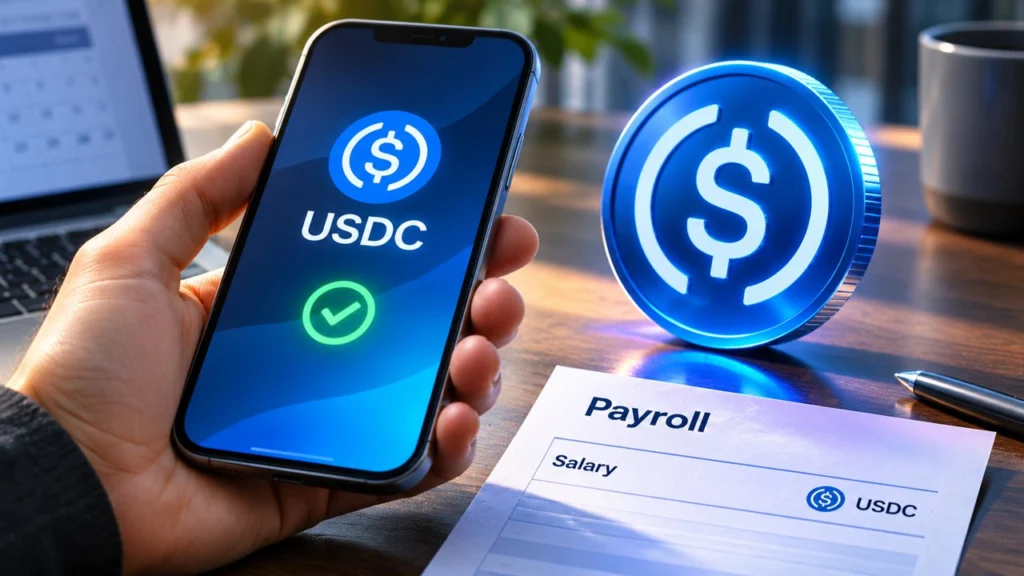
Coinbase Wallet has begun offering U.S. workers the option to receive all or part of their salaries in USDC directly on the Base network. This initiative brings stablecoins into the personal finances of millions of potential users without requiring employers to modify their payroll systems.
For years, the cryptocurrency industry has promoted the advantages of using digital assets as a means of payment, although much of its economic activity remains tied to speculation. The ability to receive a paycheck in stablecoins could contribute more to the everyday adoption of cryptocurrencies than many projects specifically designed to compete with traditional financial systems.
Getting paid in USDC removes a barrier to crypto adoption
According to Coinbase Wallet’s announcement, eligible workers will be able to receive their salaries in USDC without paying deposit fees to the platform.
Users must complete an identity verification process and provide their employers with the details of a virtual bank account. Employers will continue making payments in dollars, but these funds will automatically be converted into USDC at a 1:1 conversion rate.
The service establishes a limit of $3,000 per deposit and a daily maximum of $10,000. Funds will be credited within one to three business days.
One of the main advantages of this payment method is that it eliminates the need to purchase stablecoins on an exchange and subsequently transfer them to a self-custodial wallet.
Workers can receive a portion of their income directly on a blockchain, where they can make international transfers, access decentralized financial applications, or pay merchants that accept these assets.
The ability to choose what percentage of their salary to receive in stablecoins also facilitates gradual adoption, without forcing users to abandon their bank accounts or change all their financial habits.
Stablecoins have an advantage over Bitcoin as a means of payment
The volatility of Bitcoin and most altcoins makes them difficult to use for managing everyday household expenses. Workers are unlikely to risk the money set aside for rent or groceries on an asset that could depreciate considerably before those payments are due.
USDC allows users to benefit from blockchain infrastructure without directly exposing themselves to Bitcoin’s characteristic volatility.
This distinction should also change how growth in the cryptocurrency industry is measured. An asset’s market capitalization can increase considerably without a corresponding rise in its use to purchase goods and services.
Payroll deposits, by contrast, can generate a recurring inflow of capital into blockchain networks that does not depend exclusively on investors’ bullish expectations.
The commercial challenge will be ensuring that workers can spend those funds directly. If they need to convert their stablecoins back into dollars to cover most of their expenses, the advantages over a conventional bank account will remain limited.

USDC adoption strengthens financial intermediaries
The growth of dollar-backed stablecoins presents a contradiction for advocates of financial decentralization.
Although workers can receive their funds in self-custodial wallets, USDC relies on Circle, a company responsible for managing its reserves and capable of restricting transactions involving certain blockchain addresses.
Using these assets does not necessarily provide the same legal protections as holding money in an insured bank account.
However, requiring all cryptocurrency products to operate entirely without financial intermediaries could limit their usefulness for people who are simply looking for better payment services.
The expansion of USDC should be accompanied by greater competition among issuers, service providers, and blockchain networks. Workers must retain the freedom to choose where they keep their earnings and which infrastructure they use to conduct transactions.
Receiving a salary in stablecoins may be a more attractive alternative for millions of people than investing in cryptocurrencies in the hope of generating profits. For advocates of decentralization, the challenge lies in preserving users’ financial autonomy without sacrificing the practical advantages offered by dollar-backed assets.
Tyler Anderson
Hi there! I'm Tyler Anderson from Sweden, and I'm a Web3 Reporter. My main focus is exploring the evolution of Web3, from DAO governance to the real utility of decentralized protocols.
More from Tyler Anderson →This article is for information only and is not investment advice. We report under our Editorial Policy; to flag an error, see our Corrections Policy.