
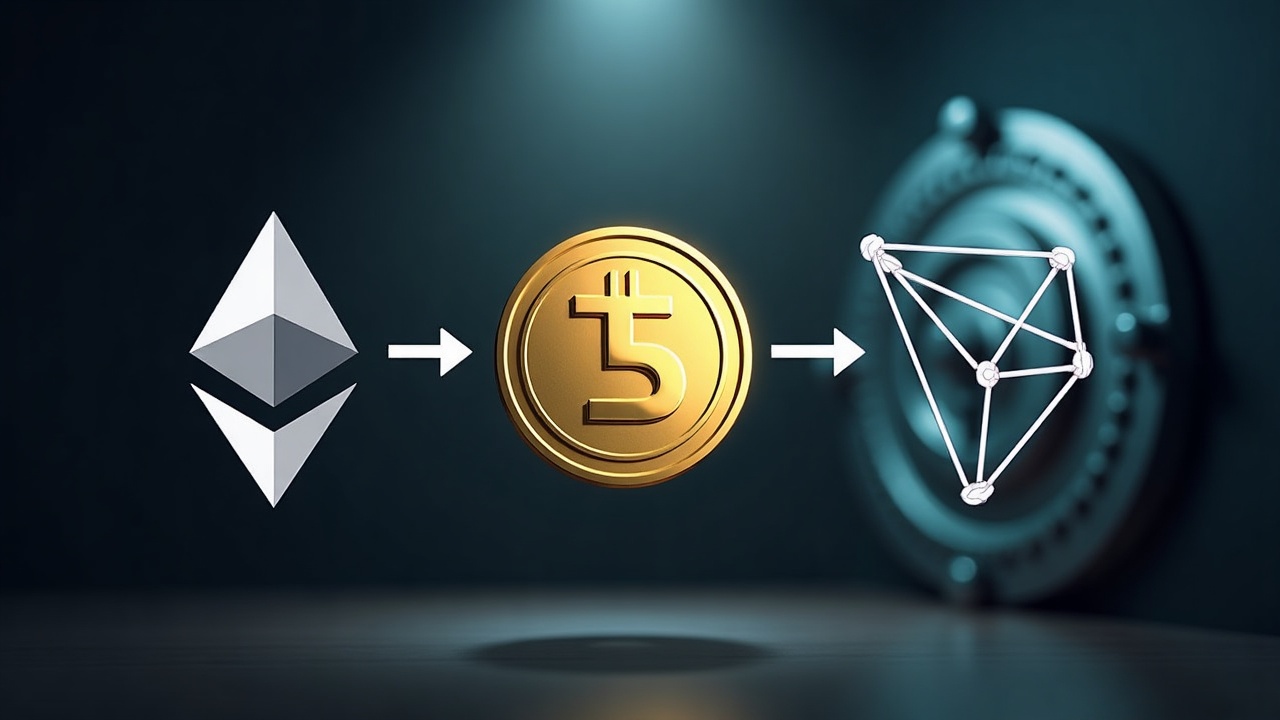
Tether’s USDT liquidity is shifting across its two largest blockchain deployments as Ethereum circulation contracts and Tron gains supply. A $500 million transfer from a Binance-associated wallet to the Tether Treasury added attention to the movement, but neither company publicly confirmed its purpose. The transaction is best treated as treasury management rather than evidence of a market sale, because issuer wallets routinely receive funds for redemptions, inventory adjustments and cross-chain operations.
Independent data confirms the direction of the migration, though not every figure attached to the latest snapshot. DefiLlama showed approximately $183.37 billion in total circulating USDT on August 4, including $89.73 billion on Tron and $74.80 billion on Ethereum. Tron’s supply increased 2.33% over one month while Ethereum’s fell 4.63%, implying changes of roughly plus $2 billion and minus $3.6 billion over that rolling period.
Treasury Transfers Do Not Automatically Reduce Supply
Tether’s chain-swap process allows an exchange with excess USDT on one blockchain to return those tokens to the issuer and receive an equivalent amount on another network. A completed chain swap redistributes liquidity without necessarily changing global USDT circulation. Tether may burn the returned tokens on the original chain or retain them in its treasury for future swaps.
The accounting distinction is important because Tether classifies tokens held in treasury as “authorized but not issued.” Those units are outside circulating supply and are not included in USDT’s market capitalization. A transfer into treasury can remove tokens from active circulation on one network, but the global effect depends on whether Tether issues matching inventory elsewhere, processes a redemption or later burns the balance.
The $500 million transaction therefore cannot establish a net contraction by itself. On-chain tracking identified the destination as the Tether Treasury, but the transfer’s underlying purpose remains unconfirmed. Without a corresponding issuance record or an official explanation, the movement does not prove an Ethereum-to-Tron swap, even though that interpretation is consistent with Tether’s documented operating process.
Tron Gains Share as Total USDT Supply Pulls Back
Tron now holds close to 49% of tracked circulating USDT, compared with roughly 41% on Ethereum. The distribution increasingly favors Tron as USDT’s largest blockchain venue, while smaller deployments on BNB Chain, Solana and other networks account for the remainder.
The frequently cited $189.5 billion supply figure is no longer current. Reuters reported that level for March 2026, while the latest DefiLlama snapshot places circulating supply near $183.4 billion. USDT supply has declined by roughly $6 billion from the first-quarter reference point, although totals can vary slightly by provider, pricing methodology and update timing. Tether also cautions that its circulation data may be delayed.
The migration does not indicate a USDT depeg or a failure of either blockchain. It reflects how Tether and its exchange clients allocate token inventory in response to network-level demand. The clearest conclusion is that liquidity has moved toward Tron while Ethereum’s USDT base has contracted, but individual treasury transfers require matching issuance, burn and redemption data before they can be classified as chain swaps or permanent supply reductions.