Stablecoin Exodus Signals Deeper Liquidity Crisis Ahead
Stablecoin outflows expose a deepening crypto liquidity crisis, increasing the risk of sharper price declines and cascading liquidations.


Billions of dollars in stablecoin outflows from centralized exchanges are weakening the cryptocurrency market’s ability to recover from its current correction. These capital outflows are accompanied by a contraction in circulating supply, reducing the resources available to finance new digital asset purchases.
Much of investors’ attention is focused on Bitcoin’s (BTC) price performance and the possibility of the cryptocurrency finding a bottom. However, deteriorating liquidity could become a much bigger problem for the market. Each new wave of selling will encounter less capital available to absorb it, potentially accelerating further price declines.
Stablecoin reserves record their biggest decline since 2023
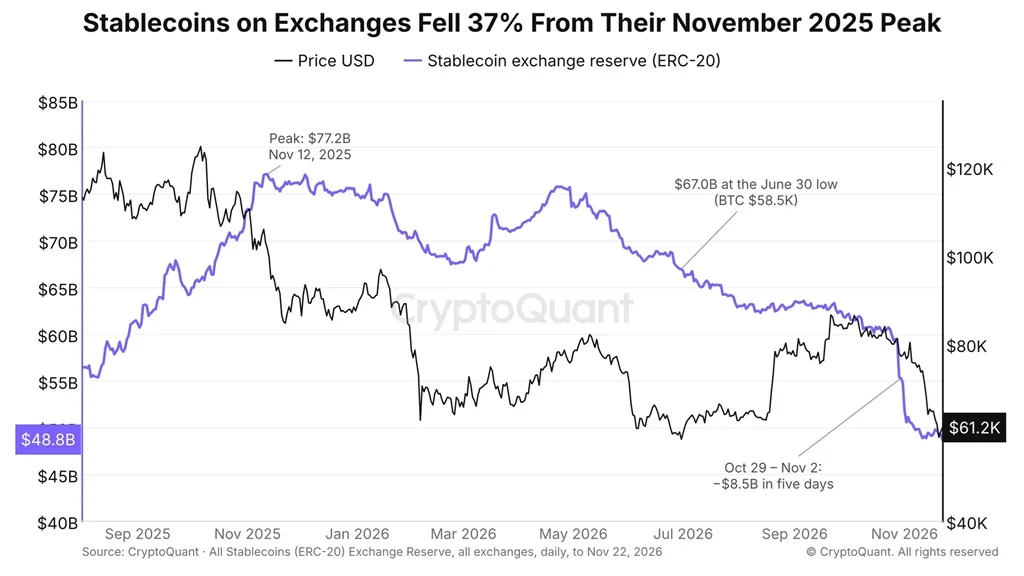
According to a CryptoQuant report, ERC-20 stablecoin reserves on centralized exchanges decreased by approximately $12 billion during the 30 days leading up to November 22.
Most of that decline came from Binance, whose reserves fell substantially following the October 29 cyberattack. However, even when excluding Binance, reserves across other platforms decreased by 9.2% during the period analyzed.
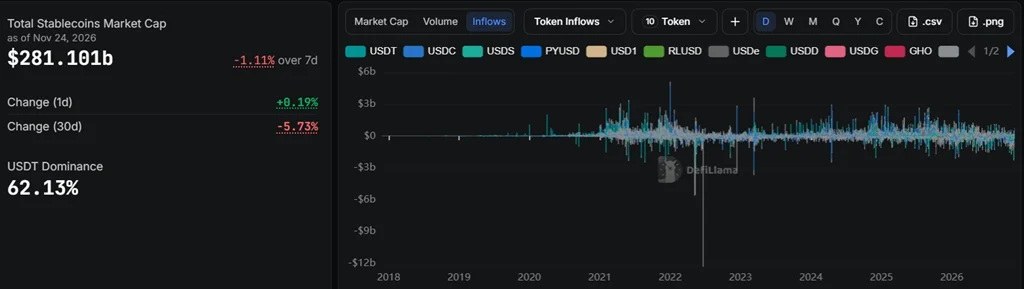
This situation also affects the supply of stablecoins outside exchanges. On November 10, DefiLlama reported that the stablecoin market capitalization had declined by $14 billion in one month, falling to $290 billion.
There is an important distinction between withdrawing stablecoins from an exchange and redeeming them for dollars. In the first case, funds can remain in private wallets or move to decentralized finance (DeFi) protocols. In the second, the reduction in supply removes capital that could otherwise be used to purchase cryptocurrencies without requiring new bank deposits.
The combination of these two developments makes it harder to maintain the assumption that investors are simply waiting for better prices before buying again.
Liquidity shortages could trigger further corrections
The consequences of stablecoin outflows can extend far beyond a decline in trading volume. Market makers use these assets to fund their operations and maintain buy and sell orders across different platforms.
When less capital is allocated to these activities, order books can lose depth and bid-ask spreads can widen. Under these conditions, a sell order can trigger a much larger price decline than during periods of abundant liquidity.
The derivatives market is another risk factor. A sharp decline can trigger the forced liquidation of leveraged positions, generating additional sell orders and increasing downward pressure on prices.
If available buyers cannot absorb that volume, prices may reach the liquidation levels of other positions. The result is a cascade of forced selling that can continue even after the initial cause of the decline has subsided.
Altcoins with lower trading volumes are particularly vulnerable to this phenomenon. Their markets require considerably less capital to experience sharp price swings, especially when liquidity providers also reduce their exposure.

Stablecoin flows could anticipate Bitcoin’s price movements
CryptoQuant’s historical analysis, covering January 2021 through November 2026, indicates that Bitcoin recorded a median decline of 4.1% during the 30 days following large stablecoin withdrawals from spot exchanges.
Although historical patterns do not guarantee that the market will behave the same way again, they provide a reference for assessing the sustainability of its next recovery attempts.
Investors should pay particular attention to net stablecoin issuance, order book depth, and deposits on spot trading platforms.
Expectations of a Bitcoin recovery without improvements in these variables could rely too heavily on short covering or short-lived speculative buying. The market needs to regain its ability to absorb large sell orders before a price recovery can be considered sustainable.
Colin Harris
I'm Colin Harris, L1s Analyst and Web3 Reporter for the United States. My day-to-day involves diving into the fundamental layers of the ecosystem, specializing in Layer 1 (L1s) networks.
More from Colin Harris →This article is for information only and is not investment advice. We report under our Editorial Policy; to flag an error, see our Corrections Policy.