Does Extreme Fear Finally Mark a Genuine Market Bottom?
Extreme fear grips the crypto market as stablecoin supply shrinks and BTC holders sell, raising doubts about whether a lasting bottom has formed.


The crypto market is experiencing one of its most pessimistic periods, with the Fear & Greed Index near 10 points, a decline in stablecoin supply, and selling among mid-sized Bitcoin holders.
These conditions resemble previous episodes of capitulation, when mounting losses and declining confidence led many investors to exit their positions.
However, extreme fear does not guarantee that the market has bottomed out. Weak sentiment may precede a recovery, but it can also persist for weeks if capital continues to leave the market.
This distinction is crucial for those who believe current prices offer a buying opportunity. The risk of another decline remains high when selling pressure coincides with shrinking available liquidity.
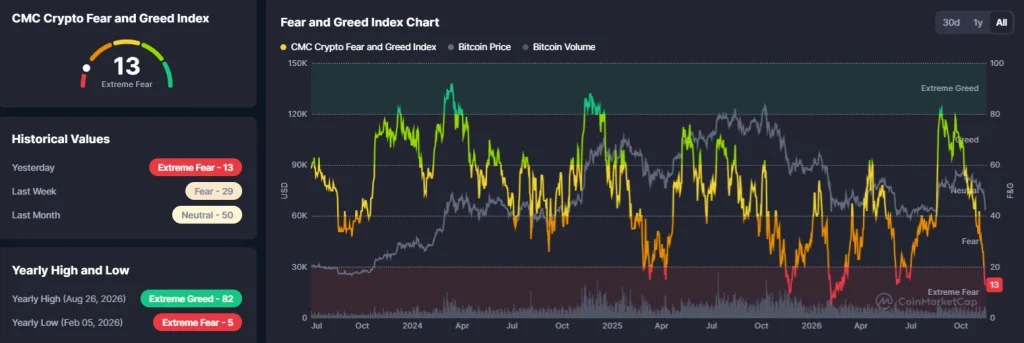
Extreme Fear Can Precede Rebounds but Does Not Guarantee a Bottom
The Fear & Greed Index combines indicators related to volatility, price movements, and other market variables to measure investor sentiment.
A reading near 10 indicates extreme fear, a condition that has historically appeared during some of Bitcoin’s sharpest corrections.
During these periods, many traders sell to limit losses or avoid an even steeper decline. Liquidations of leveraged positions can intensify the downturn and accelerate investor exits.
Once much of that selling has ended, the reduction in immediate pressure can support rapid recoveries. Even a moderate influx of buyers can trigger substantial gains if the market has become excessively tilted toward bearish positions.
But there is a difference between a rebound and a sustainable recovery.
Prices can rise after capitulation without any improvement in the conditions that triggered the selling. If buyers fail to maintain their positions, the market may return to its previous lows.
Buying solely because fear has reached extreme levels means ignoring how much capital may still leave the market.
The Contraction of the Stablecoin Market
The decline in stablecoin market capitalization deserves as much attention as Bitcoin’s price performance.
These assets allow investors to maintain dollar-denominated liquidity within the crypto ecosystem and facilitate transactions across different platforms.
When their supply decreases, it may indicate that some capital is leaving the system, although redemptions and changes in circulating supply can also occur for other reasons.
Reduced stablecoin availability can make a recovery in demand more difficult, especially if investors prefer withdrawing funds rather than taking advantage of lower prices.
The behavior of investors holding mid-sized Bitcoin balances is also concerning.
If these traders continue distributing their coins, the market must absorb additional supply even after derivatives liquidations have ended.
These sales carry different implications because they do not necessarily result from automatic closures of leveraged positions. They may reflect deliberate decisions to reduce exposure.
The combination of reduced liquidity and spot selling presents a deeper problem than a correction driven exclusively by excessive leverage.

The Risk of Further Declines
Macroeconomic conditions are not particularly favorable for an immediate recovery either. A stronger dollar, elevated bond yields, and expectations of restrictive interest rates can make volatile assets less attractive.
Bitcoin may experience substantial rebounds under these conditions, but establishing an upward trend requires buyers capable of absorbing selling pressure over an extended period.
Extreme sentiment offers a potential advantage for investors with long investment horizons who can tolerate further losses. Depressed prices reduce the cost of entry compared with previous levels.
However, that opportunity does not justify assuming the risks have disappeared.
The risk-reward balance is beginning to look more attractive for gradual purchases than for aggressive, leveraged positions. Spreading out purchases allows investors to preserve liquidity if prices fall further, without having to identify the exact bottom.
For short-term traders, the situation is different. Volatility can cause rapid losses even when the market’s broader direction eventually turns favorable.
A recovery in ETF inflows, stabilization of stablecoin supply, and a sustained reduction in selling by Bitcoin holders would provide stronger evidence that a market base is forming.
Extreme fear can create opportunities, but it is still not sufficient proof of a definitive capitulation. As long as liquidity continues to leave the market and Bitcoin holders keep distributing their coins, further lows remain possible.
The priority should be distinguishing between prices that merely appear cheap and demand that is genuinely beginning to recover.
Derek Vaughn
Hi! I'm Derek Vaughn, a Market Research Specialist based in Nigeria. I analyze crypto markets from a global perspective, trying to understand what's behind price movements and liquidity trends. I've been covering the digital ecosystem for several years, and my style is based on rigorous, data-driven research.
More from Derek Vaughn →This article is for information only and is not investment advice. We report under our Editorial Policy; to flag an error, see our Corrections Policy.