Why Are Crypto Giants Liquidating Holdings to Buy Their Own Stock?
CoinShares sells Ethereum and Solana reserves to fund a $40 million share buyback, challenging corporate crypto treasury strategies.

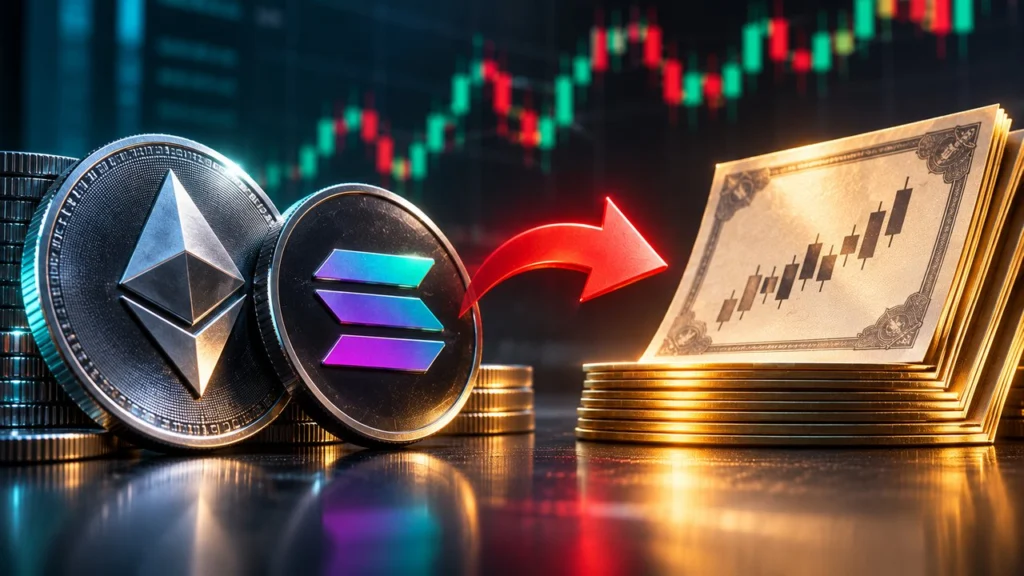
CoinShares sold all its corporate Ethereum reserves and half of its Solana holdings to fund a share buyback program of up to $40 million. Its decision raises a contradiction for companies in the crypto sector: why sell digital assets to invest in their own shares?
The asset manager raised $19.3 million through these transactions and believes that buying back its shares offers a more attractive opportunity than holding the cryptocurrencies it sold.
The decision challenges the idea that accumulating digital assets is always the best strategy for a company operating in the sector.
However, selling cryptocurrencies to repurchase shares can be a sound financial decision, especially when management believes the market is undervaluing its business.

CoinShares Favors Its Own Shares Over Ethereum and Solana
According to CoinShares’ quarterly results, the company raised $16.6 million from selling its corporate Ethereum reserves and $2.7 million from selling half of its Solana holdings.
The $19.3 million represents approximately 48% of the share buyback program authorized by its board of directors.
The company can repurchase up to $40 million of its own shares, although purchases will depend on market conditions and applicable restrictions.
Therefore, the authorization does not mean CoinShares has already repurchased that amount in shares.
The transaction also does not directly affect the assets it manages for clients. The cryptocurrencies sold belonged to its corporate treasury, not the investment funds it offers.
This distinction matters because CoinShares continues to generate revenue from products linked to digital assets.
The company managed approximately $7.4 billion at the end of September, compared with $5.5 billion three months earlier.
Share Buybacks May Offer More Value Than Holding Cryptocurrencies
When a company repurchases its shares, it can reduce the number of shares outstanding and increase the proportional ownership stake of investors who retain their holdings.
If shares trade below their economic value, using available capital to repurchase them can benefit shareholders.
But that advantage depends on the price paid. A buyback executed at an excessive valuation can also destroy value.
CoinShares has concrete reasons to reconsider how it allocates its resources.
Its quarterly revenue declined from $50.3 million to $27.7 million compared with the same period in 2025. Although it reported a net profit of $39.6 million, its business remains exposed to fluctuations in the crypto market.
The company could hold Ethereum and Solana in anticipation of a price recovery. However, that possibility does not guarantee better returns than repurchasing its own shares.
The purpose of a corporate treasury is to manage the company’s capital, not to maintain a speculative position indefinitely.

Crypto Treasuries Need to Justify Their Decisions
The transaction also challenges the narrative promoted by companies that present cryptocurrency accumulation as a strategy that always benefits shareholders.
Holding Bitcoin, Ethereum, or Solana can generate profits during a bull market, but it also introduces volatility into corporate balance sheets.
When conditions change, executives must compare the expected returns on those assets with other investment opportunities.
The problem arises when a company turns accumulation into an ideological commitment and stops evaluating its costs.
CoinShares has chosen a traditional alternative: selling part of its financial assets and using the proceeds to support the value of its shares.
That does not prove Ethereum or Solana have lost their appeal. Nor does it mean the company is abandoning the digital asset business.
But it does acknowledge that holding cryptocurrencies is not always the best use of available capital.
The buyback does not guarantee a stock price recovery either. If revenue continues to deteriorate, reducing the number of shares outstanding will not solve operational problems.
CoinShares’ strategy deserves a favorable assessment for its financial discipline, although its outcome will depend on the price at which the company actually repurchases its shares.
Derek Vaughn
Hi! I'm Derek Vaughn, a Market Research Specialist based in Nigeria. I analyze crypto markets from a global perspective, trying to understand what's behind price movements and liquidity trends. I've been covering the digital ecosystem for several years, and my style is based on rigorous, data-driven research.
More from Derek Vaughn →This article is for information only and is not investment advice. We report under our Editorial Policy; to flag an error, see our Corrections Policy.