Can Today’s $7 Billion Options Expiry Trigger the Next Violent Crypto Squeeze?
Bitcoin’s $7 billion options expiry threatens to intensify volatility as weak spot demand and thin liquidity expose BTC to further losses.


The cryptocurrency market faces the monthly expiration of Bitcoin (BTC) options on Deribit, with a notional value of approximately $7 billion. Unlike October, when optimism prevailed among derivatives traders, investors have considerably increased their hedging positions against further price declines.
Lower participation among U.S. investors during the Thanksgiving holiday could intensify price fluctuations over the next 48 hours. Although conditions could favor a sharp rebound, weak spot demand makes it more likely that sellers will regain control of the market.

Options traders prepare for further declines
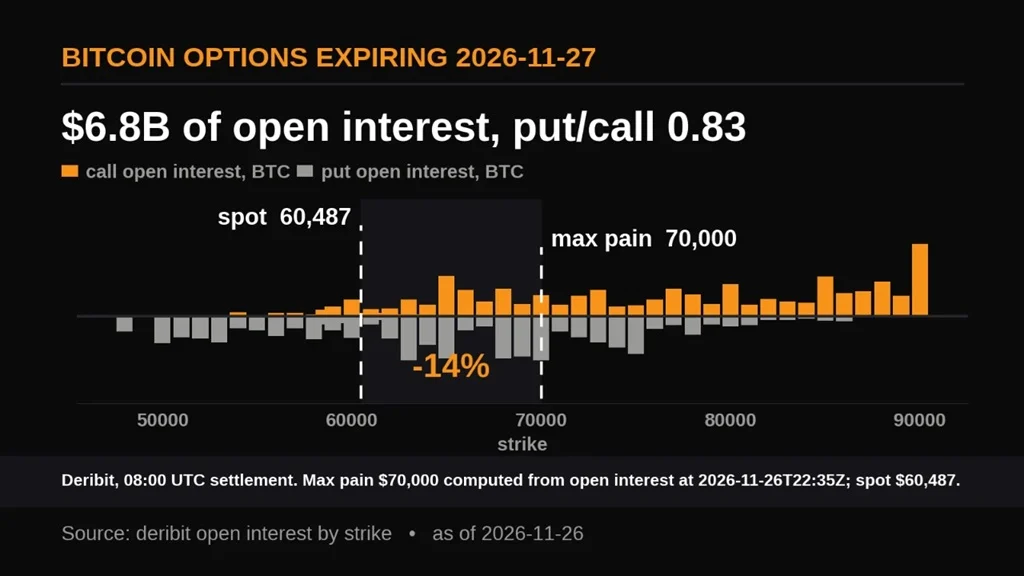
According to an analysis published on CryptoQuant, Bitcoin contracts expiring on November 27 amounted to approximately $6.8 billion, equivalent to 25.4% of the open interest in these derivatives on Deribit.
The $65,000 strike price had the highest individual open interest, with contracts worth approximately $328 million and a predominance of put options.
The put-to-call ratio stood at 0.83. Although call options still outnumbered puts, traders were paying higher premiums to protect themselves against a decline in Bitcoin’s price.
The increased demand for hedging does not necessarily mean that all these investors expect further declines. Some may hold substantial spot positions and use these instruments to limit their losses.
The expiration of these contracts will leave some investors without the protection they acquired over the past few weeks. Those wishing to maintain it will need to allocate capital to new hedges or directly reduce their exposure to Bitcoin.
The options market’s max pain point
Deribit data compiled by Castle Labs placed the so-called max pain level at $70,000, approximately 16% above BTC’s price before expiration.
This indicator identifies the settlement price at which options buyers would collectively receive the smallest payout on their contracts, excluding the premiums they paid.
The gap between these prices largely reflects Bitcoin’s depreciation throughout November. Many of these contracts were opened when BTC was trading considerably above its current levels.
Using max pain as a bullish price target under these circumstances is particularly risky. Market intermediaries can adjust their hedges without Bitcoin necessarily approaching that price.
Moreover, the expiration of options with such a large notional value does not mean that billions of dollars will immediately flow into or out of the spot market.

What happens if Bitcoin falls below $60,000?
The range between $60,000 and $62,000 will be the focus of attention over the weekend. A break below its lower boundary could trigger liquidations of leveraged long positions and drive Bitcoin back toward its recent lows.
Conversely, a sustained recovery above $62,000 could force some bearish traders to close their positions and temporarily accelerate the rally.
The options market helps identify price levels where financial exposure is substantial, but it cannot determine with certainty how market intermediaries will respond. Their hedging activity will depend on the positions they hold and how they manage their risks.
As long as investors continue withdrawing capital from U.S. ETFs and spot demand remains weak, another decline appears more likely than a sustained recovery.
Buyers need to demonstrate that there is sufficient capital available to absorb selling pressure once the adjustments associated with the expiration are complete.
Weekend trading could make this distinction particularly important. With fewer participants and limited market depth, relatively modest orders can produce substantial price swings that exaggerate the strength of either buyers or sellers.
If Bitcoin manages to consolidate above $62,000 alongside an increase in spot trading volume and without a disproportionate rise in leverage, there would be stronger grounds for questioning that bearish outlook. A rally driven exclusively by traders closing short positions would offer considerably less reassurance.
Derek Vaughn
Hi! I'm Derek Vaughn, a Market Research Specialist based in Nigeria. I analyze crypto markets from a global perspective, trying to understand what's behind price movements and liquidity trends. I've been covering the digital ecosystem for several years, and my style is based on rigorous, data-driven research.
More from Derek Vaughn →This article is for information only and is not investment advice. We report under our Editorial Policy; to flag an error, see our Corrections Policy.