Massive Options Expiry Risks Amplifying Bitcoin’s Fragile Rebound
A $2.47 billion Bitcoin and Ethereum options expiry raises volatility risks as thin liquidity and leveraged positions threaten the recovery.


The expiry of approximately $2.47 billion in Bitcoin and Ethereum options is putting pressure on a market still struggling to recover from heavy liquidations and a prolonged price decline.
According to data released by Deribit, around $2.17 billion corresponds to Bitcoin options, while another $303 million is linked to Ethereum.
This comes as the market faces limited liquidity, leveraged positions under pressure, and elevated risk aversion.
However, the size of the expiry alone cannot predict whether prices will rise or fall. Options can trigger substantial hedging adjustments, but their impact depends on how traders are positioned.
The question is whether those adjustments will support a Bitcoin recovery or intensify selling pressure.
Options Show Expectations Far Above Current Prices
Expiring Bitcoin contracts have a put-to-call ratio of 0.61, according to Deribit data.
This means there are more call options than put options within this expiry.
The max pain level stands at approximately $70,000, considerably above Bitcoin’s current price of around $59,000.
For Ethereum, the put-to-call ratio reaches 1.23, while max pain is near $1,950.
These differences indicate that positioning is not identical across the two assets.
But max pain is not a price target. It represents the price at which outstanding options would have the lowest aggregate intrinsic value at expiry.
There is no mechanism forcing the market to reach that price.
In fact, the gap between Bitcoin’s current price and $70,000 can also be interpreted as a buildup of positions that will lose value if the asset remains near its current levels.

Hedging Can Amplify Price Swings
The real problem arises when intermediaries must adjust their hedges in response to sharp price changes.
Market makers typically buy or sell assets and futures to manage the exposure created by the options they hold.
Depending on their positioning, those trades can either cushion or amplify Bitcoin’s price movements.
If the price starts rising and certain traders need to buy BTC or futures to adjust their hedges, that additional demand could accelerate the rebound.
There is also the possibility that traders holding leveraged bearish positions will be forced to close them through purchases, potentially fueling a rapid recovery.
However, a major options expiry does not guarantee a short squeeze.
For that to happen, there must be enough vulnerable short positions and sufficient buying pressure to force them to close.
The opposite scenario also deserves consideration. If Bitcoin loses support levels and hedging adjustments require additional selling, that pressure could accelerate losses.
With less depth in order books, a relatively small amount of trading can produce more pronounced price swings.
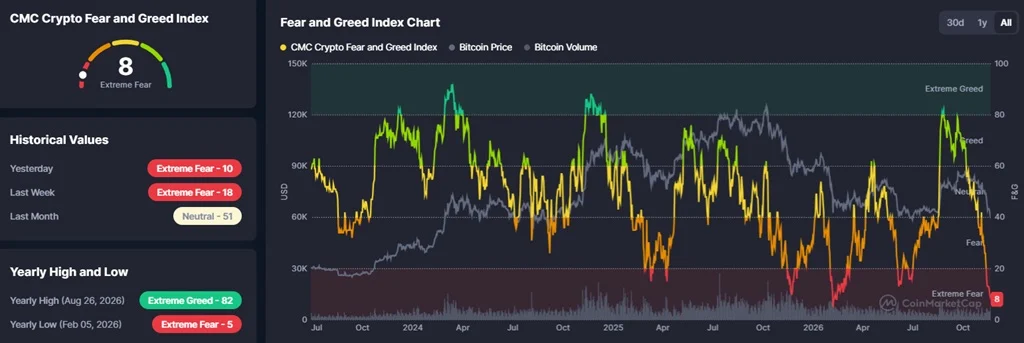
Fear and Declining Leverage
The market is approaching the options expiry after a period of liquidations that has reduced many investors’ exposure.
The decline in derivatives open interest may reduce some of the risks associated with excessive leverage.
But it also means fewer positions remain available to fuel a recovery through forced closures.
This distinction matters because some violent rebounds occur when large numbers of leveraged short sellers are forced to buy back their positions.
If many of those positions have already disappeared, the market will need new buyers to sustain a rally. Meanwhile, Bitcoin’s implied volatility has increased.
Data compiled by OptimistFi placed 30-day implied volatility near 44.1%, compared with 37.5% a week earlier.
That increase indicates that options were pricing in larger price swings, although it does not specify their direction.
The combination of fear, reduced liquidity, and shifting hedges favors sharp movements, but offers little certainty about how long they will last.

A Rebound Would Not Resolve Market Weakness
A recovery after the options expiry is a reasonable possibility.
As contracts expire, some hedging requirements may disappear, allowing prices to respond more freely to buying and selling orders.
However, a rally driven by technical adjustments does not necessarily represent a solid recovery in demand.
Traders can close positions, remove hedges, or roll contracts into later expiries without materially changing their economic exposure.
That is why the notional value of expiring options should not be confused with an equivalent amount of Bitcoin that must necessarily be bought or sold.
The distinction between these concepts is essential to understanding the event. The market needs to establish whether buying continues after the immediate pressure of the expiry has faded.
If Bitcoin recovers solely because positions are being closed, the rebound could run out of momentum once that temporary demand disappears.
If, instead, buyers emerge who are willing to hold their positions and market depth improves, the recovery would have a stronger foundation.
The options expiry may affect Bitcoin’s price behavior for several hours, but the ability to sustain higher prices will depend on the demand that remains after derivatives positions have been adjusted.
Derek Vaughn
Hi! I'm Derek Vaughn, a Market Research Specialist based in Nigeria. I analyze crypto markets from a global perspective, trying to understand what's behind price movements and liquidity trends. I've been covering the digital ecosystem for several years, and my style is based on rigorous, data-driven research.
More from Derek Vaughn →This article is for information only and is not investment advice. We report under our Editorial Policy; to flag an error, see our Corrections Policy.