Q3 ETF Buying by Institutions Clashes With Massive November Outflows
Institutional Bitcoin buying surged in Q3, but billions in ETF outflows raise doubts about long-term demand and market stability.


Institutional investors increased their holdings in Bitcoin ETFs during the third quarter, but November has presented a very different picture: billions of dollars are leaving the funds, and BTC continues to decline.
According to a Galaxy Research report, institutions required to file Form 13F added net exposure equivalent to 49,229 BTC between July and September, valued at approximately $4.11 billion at the end of the quarter.
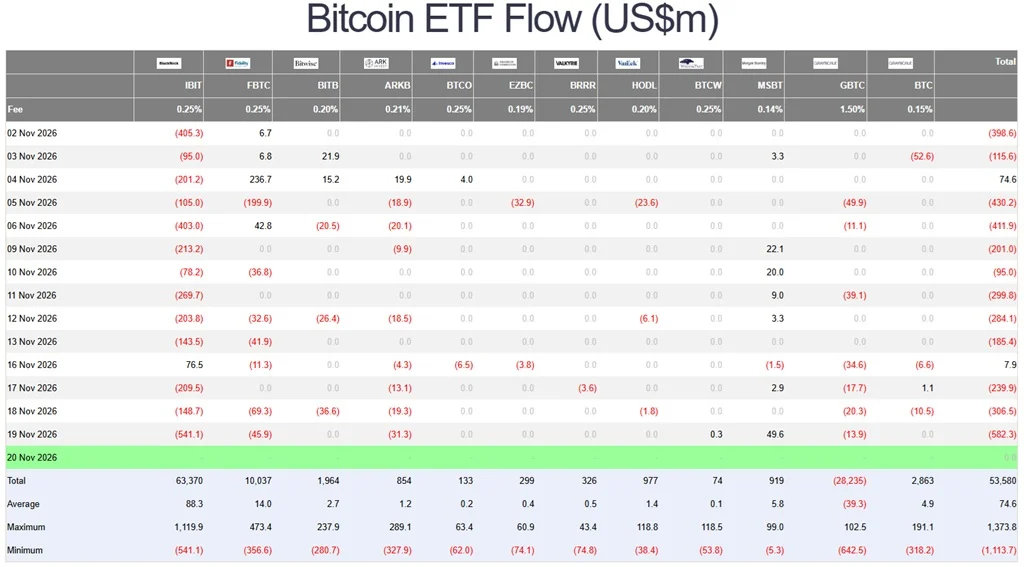
However, Farside Investors data shows nearly $3.47 billion in net outflows from U.S. Bitcoin ETFs during the first 14 trading sessions of November.
This apparent contradiction raises a fundamental question: Are major investors accumulating Bitcoin while others sell, or have the institutional purchases made in the previous quarter already lost their importance?
Answering that question requires distinguishing between investors adding Bitcoin to long-term portfolios and those using ETFs for short-term trades. Both participate in the same market, but they do not necessarily pursue the same objectives.
Institutional Buying Was Far From Uniform
Galaxy identified approximately 2,166 managers holding Bitcoin ETF positions at the end of September. Their holdings reached a record 356,491 BTC, following three consecutive quarters of net selling.
The recovery was led by major financial institutions.
Wells Fargo increased its exposure by 14,636 BTC equivalents, Bank of America added 7,201, and Brevan Howard acquired another 8,606. But these figures require careful interpretation.
The 50 largest holders increased their positions by 59,578 BTC equivalents. All other managers combined reduced their exposure by 10,349 BTC.
Therefore, institutional accumulation depended primarily on a relatively small group of major holders.
Not all these purchases necessarily represent investments intended to hold Bitcoin for years.
Banks may hold ETF shares to facilitate transactions for clients. Hedge funds may buy ETFs while simultaneously selling futures to profit from price differences.
Form 13F reports long positions at the end of each quarter, but it does not reveal every hedge established through derivatives.
Mistaking a reported position for a permanent bullish bet can lead to misleading conclusions.

ETFs Face Immediate Selling Pressure
The situation changed considerably during November.
According to Farside, U.S. ETFs recorded approximately $3.468 billion in net outflows through November 19, with twelve negative sessions out of fourteen.
BlackRock’s IBIT ETF recorded $541.1 million in outflows on November 19, while the ETF market as a whole lost $582.3 million that day.
These figures represent net fund flows, not necessarily sales made by the same managers who appeared as buyers in September.
That distinction is crucial because quarterly holdings data and daily fund flows neither identify the same investors nor cover the same periods.
Galaxy also calculated that total Bitcoin ETF holdings declined by 38,531 BTC between the end of September and November 16.
That reduction confirms an actual decline in exposure through these investment vehicles. However, it does not establish how much of the selling came from financial advisers, hedge funds, or individual investors.
Financial Advisers Could Provide Greater Stability
The most interesting finding in Galaxy’s report is not simply the volume of purchases.
Financial advisers and wealth management platforms held 144,307 BTC equivalents, representing approximately 40.5% of the positions disclosed through Form 13F filings.
This category also increased its holdings for nine consecutive quarters. These managers typically oversee diversified portfolios with predefined allocations across different asset classes.
If Bitcoin loses value, some may buy more to restore their portfolios’ target allocation, rather than selling simply because the market is declining.
That behavior could provide more stable demand than arbitrage trading or investments driven by recent performance. But it does not guarantee a price floor.
Advisers may reduce their allocations if their clients’ needs, risk policies, or financial expectations change.
There is also an important limitation: managers filing Form 13F accounted for just 27.6% of the Bitcoin held by ETFs at the end of September.
Most holders are not represented in those disclosures.

Who Is Still Buying?
Third-quarter accumulation shows that Bitcoin continues to attract institutional buyers even after extended periods of weakness.
November’s outflows, meanwhile, confirm that the presence of major financial institutions does not prevent massive selling or guarantee stability.
The argument that patient institutional capital remains in the market is reasonable, particularly given the growth in holdings managed by financial advisers.
However, there is still insufficient evidence to conclude that those purchases are offsetting current outflows.
The next round of Form 13F filings will help establish which managers maintained their positions during the decline and which reduced their exposure.
For now, the market faces a much more concrete question: whether purchases by long-term investors can absorb sales from those who need liquidity or want to exit their positions.
Colin Harris
I'm Colin Harris, L1s Analyst and Web3 Reporter for the United States. My day-to-day involves diving into the fundamental layers of the ecosystem, specializing in Layer 1 (L1s) networks.
More from Colin Harris →This article is for information only and is not investment advice. We report under our Editorial Policy; to flag an error, see our Corrections Policy.