Bittensor Launches Gamma Service Credits for AI Payments
Bittensor launches Gamma, dollar-valued service credits that burn subnet Alpha and let wallets and AI agents pay for participating services.

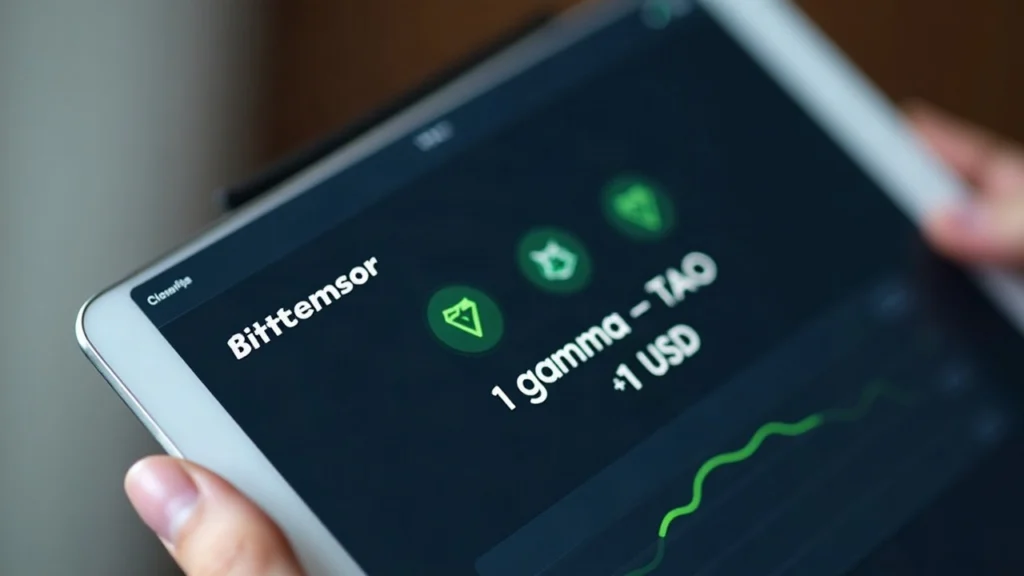
OpenTensor Foundation has introduced Gamma, a native payment mechanism intended to make Bittensor subnet services easier to purchase from a common wallet. In its official announcement, the foundation said users and AI agents can access participating services without creating separate accounts or obtaining conventional API credentials from every provider. Gamma introduces a common payment standard across Bittensor, but the credits themselves remain specific to individual subnets.
According to the official Bittensor documentation, Gamma is a dollar-valued service credit rather than a freely transferable cryptocurrency. One Gamma is minted for each dollar of value assigned to Alpha burned during creation. The credits cannot be redeemed back into Alpha or TAO, transferred into another coldkey’s ownership or traded as a conventional token. A subnet ultimately determines whether it accepts Gamma and how much credit a particular service costs.
Introducing Gamma Tokens
A native payment system for Bittensor’s AI economy.
Users and AI agents will be able to access and pay for subnet services with a Bittensor wallet, without separate accounts or API keys for each subnet. pic.twitter.com/lz4AviBTzs
— Openτensor Foundaτion (@opentensor) November 10, 2026
Alpha Burns Connect AI Usage to Subnet Economics
Users can create Gamma either with TAO or with Alpha already held in a subnet stake. When TAO is used, the protocol first buys that subnet’s Alpha and burns it; existing staked Alpha can instead be burned directly. Every Gamma mint therefore permanently removes Alpha from the relevant subnet’s supply while converting its calculated value into prepaid service credit.
The valuation mechanism is designed to make short-lived Alpha price spikes harder to exploit. Burned Alpha is valued using the lower of its current spot price or a separate Gamma price. The latter falls immediately when spot declines but moves upward gradually, with the gap halving roughly every 600 blocks. A TAO/USD oracle then converts the resulting TAO value into dollar-denominated Gamma. The design limits how quickly a sudden Alpha rally can increase the amount of service credit minted from the same quantity of tokens.
That link between actual service consumption and token economics addresses a recurring question around decentralized AI networks: whether emissions translate into paying demand. Earlier analysis of Bittensor subnet subsidies versus organic revenue highlighted the gap that can emerge when token incentives substantially exceed customer-generated income. Gamma creates an onchain mechanism through which service demand can directly generate Alpha burns, although meaningful economic impact will depend on actual usage rather than the existence of the payment rail.
Hotkeys Become Service Payment Credentials
Gamma is stored in deposits owned by a coldkey but indexed by a hotkey. The hotkey signs service requests and effectively serves as the customer’s API credential, while an authorized spender charges the corresponding deposit before providing the requested service. Users can impose daily spending caps, pause spending or move Gamma between their own deposits. This gives software agents programmable payment authority without handing the service unrestricted control over the wallet.
The model resembles a wider move toward machine-native payment infrastructure. Algorand developers are already testing x402-based payments for autonomous AI services, while Render’s proposed Forth AI gateway combines model routing with programmable payments. Gamma differs by embedding payment credits directly into Bittensor’s subnet and Alpha-token architecture instead of relying primarily on transferable stablecoins.
The network-wide Gamma switch is now active, but each subnet must enable the feature independently before customers can mint and spend its credits. Early tracking shows only limited activity so far, including a $0.42 mint-and-spend transaction on Terza Inference, while Attune has also enabled the system. Those transactions establish that Gamma is operational, not that it has yet reached material commercial adoption.
Bittensor’s broader economics already connect TAO and subnet Alpha tokens through staking and emissions, while TAO itself has increasingly traded as part of the decentralized AI asset sector. Gamma adds a separate demand pathway tied specifically to purchasing services rather than staking or speculative exposure. Its significance will depend on how many subnets adopt the standard and whether users and autonomous agents generate recurring paid activity through it.
Tyler Anderson
Hi there! I'm Tyler Anderson from Sweden, and I'm a Web3 Reporter. My main focus is exploring the evolution of Web3, from DAO governance to the real utility of decentralized protocols.
More from Tyler Anderson →This article is for information only and is not investment advice. We report under our Editorial Policy; to flag an error, see our Corrections Policy.