Crypto’s Leverage Is Moving to Altcoins — and That Could Change the Next Market Crash
Traders are building more positions in altcoins, where buyers can be harder to find during a selloff


Bitcoin (BTC) now carries less leverage than it did a year ago. Meanwhile, traders are building more positions in altcoins, where buyers can be harder to find during a selloff. If prices fall sharply, these smaller markets could face heavier losses and trigger wider selling across crypto.
According to a Barron’s report, total crypto open interest rose 15% in one week, while Bitcoin’s fell 6%. Open interest measures derivatives contracts that traders have not yet closed. The figures suggest trading activity is moving beyond Bitcoin, but they don’t necessarily indicate lower market risk.
Bitcoin’s Falling Leverage Does Not Tell the Whole Story
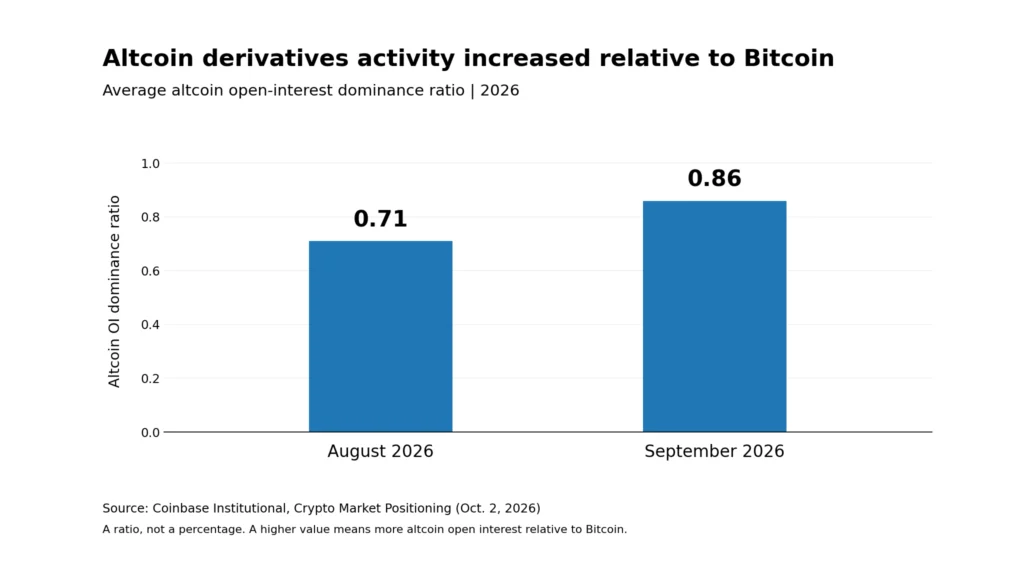
The trend started before October. Coinbase reported on October 2 that its measure of altcoin open-interest dominance averaged 0.86 in September, up from 0.71 in August. Meanwhile, Bitcoin’s leverage ratio fell for the fourth straight month and reached its lowest level since August 2024.
Lower Bitcoin leverage could reduce selling pressure during a market drop. However, growing altcoin positions may bring new risks, especially in smaller markets with fewer buyers.
Open interest alone does not show how much risk traders are taking. Some use futures to make profits, and others use them to protect their holdings. The data also do not confirm that traders are moving directly from Bitcoin to altcoins. The bigger concern is liquidity. If traders build large positions in altcoins with few buyers, even a small selloff could cause heavy losses.
Why Altcoins Could Face Bigger Losses During a Market Crash
The October 10, 2025 crash showed how quickly leveraged trading can cause heavy losses. According to Galaxy Research, more than $19 billion in crypto positions were liquidated within 24 hours. Tokens outside Bitcoin and Ethereum fell around 33% in just 25 minutes.
One major problem was the lack of buyers as traders rushed to sell. A year later, market liquidity has recovered unevenly. CoinDesk Research reported on October 10 that Bitcoin and Ethereum had rebuilt much of their order-book liquidity since the crash.
By October 7, Bitcoin had around $11.7 million in orders within 1% of its market price. That was about 75% more than during the October 2025 crash. However, smaller altcoins have not recovered as well. CoinDesk found that their order-book depth within 5% of market prices had fallen by nearly a third since January 2025, reaching around $2 million.
The figures cover different price ranges, so they cannot be compared directly. Traders who use borrowed money may struggle to keep their positions open. As a result, exchanges may automatically close their trades. These forced sales can push prices lower, especially when there are fewer buyers.
Could the Next Crypto Crash Start With Altcoins?
Another major crash is not certain. Galaxy Research found that overall leverage remains below its level before the October 2025 selloff. Some exchanges have also improved their margin rules and liquidation systems, which could help limit losses. Meanwhile, larger altcoins generally have better liquidity than smaller tokens.
However, rising leverage, high funding rates and weaker liquidity could signal growing risks. If prices fall sharply, traders may have to sell other holdings to cover their losses. This could spread selling pressure across the crypto market. The next major selloff could therefore start in altcoins rather than Bitcoin, especially if leveraged positions continue to grow without enough liquidity to support them.
On October 13, CoinGecko recorded Bitcoin open interest at around $68.4 billion, up 1.9% over 24 hours. XRP’s open interest rose 7.3% to $4.56 billion. However, Ethereum fell 1.2% to $45.2 billion, while Solana dropped 2.5% to $9.63 billion. The figures show that leveraged trading is not growing evenly across altcoins.
Syed Ali Haider
I'm a crypto journalist, editor, and SEO specialist with over five years of experience in the cryptocurrency industry and more than 6,000 articles published across various outlets.
More from Syed Ali Haider →This article is for information only and is not investment advice. We report under our Editorial Policy; to flag an error, see our Corrections Policy.