Banks Push Senate to Tighten Stablecoin Yield Rules in CLARITY Act
Banks lobby senators to tighten CLARITY Act language on stablecoin rewards ahead of the May 14 markup.

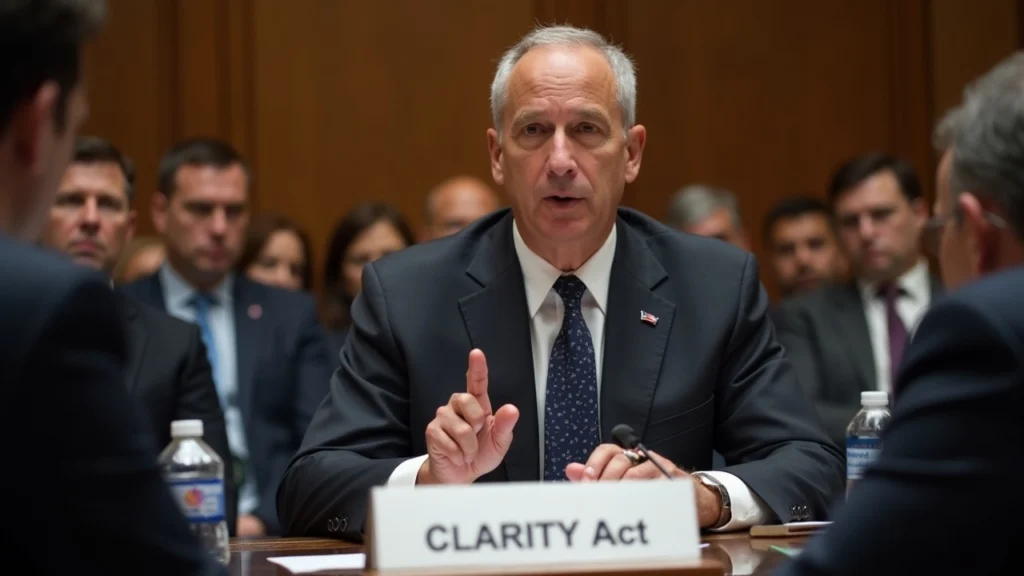
The American Bankers Association and allied trade groups have escalated lobbying ahead of the May 14, 2026 Senate Banking Committee markup of the Digital Asset Market Clarity Act. Their campaign targets stablecoin reward language they say could function like deposit interest, potentially pulling liquidity away from federally insured banks.
The dispute centers on Section 404 of the CLARITY Act and compromise language negotiated by Senators Thom Tillis and Angela Alsobrooks. Banking groups argue the current text leaves too much room for activity-based rewards that could scale with customer balances, holding duration or account tenure.
Banks Warn of Deposit Flight and Lending Pressure
Bank lobbyists say the bill should more clearly block payments that are not called yield but operate in a similar way. Their proposed edits would remove the word “solely” from the ban on rewards tied to stablecoin holdings and replace “economically or functionally equivalent” with a broader “substantially similar” standard.
The industry also wants lawmakers to close allowances for rewards calculated by balance, duration or tenure. In the banks’ view, stablecoin incentives that track how much or how long users hold tokens could become indistinguishable from interest on deposits.
The stakes, according to banking materials, are significant. Trade groups argue that permissive stablecoin rewards could reduce lending capacity by about 20% and, under some scenarios, contribute to deposit outflows as large as $6.6 trillion.
“We need your help to drive this message home before senators consider this legislation,” ABA President and CEO Rob Nichols wrote in a call to action circulated to bank executives. The message reflects a coordinated late-stage push to shape the markup text before senators vote.
Crypto Firms Call the Push Protectionist
Crypto firms and some senators have characterized the banking campaign as protectionist. Their position is that the compromise already bans passive stablecoin interest while preserving limited activity-based rewards similar to credit-card points or platform incentives.
The debate intensified after the Senate released updated legislative text on Monday, May 11, 2026, with further amendments expected on Tuesday, May 12. That timing gives lobbyists a narrow window to influence the final language before the committee markup.
The White House Council of Economic Advisers has taken a less alarmist view, saying a ban on stablecoin yield would have a negligible effect on bank lending. Banking groups counter that the CEA underestimates future stablecoin growth, especially if the market expands from roughly $300 billion today toward as much as $2 trillion with yield-like incentives.
The outcome will directly affect product economics. If senators adopt the banks’ proposed edits, firms would face a much narrower design space for customer rewards, along with higher compliance costs around incentive programs.
Treasury teams will also need contingency plans. Changes to activity-based rewards could alter user balances, liquidity flows and platform funding models, making stablecoin outflow scenarios and product-margin sensitivity key operational considerations.
The May 14 markup is now the immediate decision point, with the White House still targeting July 4 for passage. The final language will determine whether the CLARITY Act advances with tighter stablecoin guardrails or another round of extended negotiations between banks, crypto firms and lawmakers.
Tyler Anderson
Hi there! I'm Tyler Anderson from Sweden, and I'm a Web3 Reporter. My main focus is exploring the evolution of Web3, from DAO governance to the real utility of decentralized protocols.
More from Tyler Anderson →This article is for information only and is not investment advice. We report under our Editorial Policy; to flag an error, see our Corrections Policy.