Traceforms Enters NFT Top 10 as On-Chain Art Gains Ground
Traceforms enters CryptoSlam’s NFT top 10 as fully on-chain Ethereum art gains momentum alongside Credits, CryptoPunks and Argonauts.

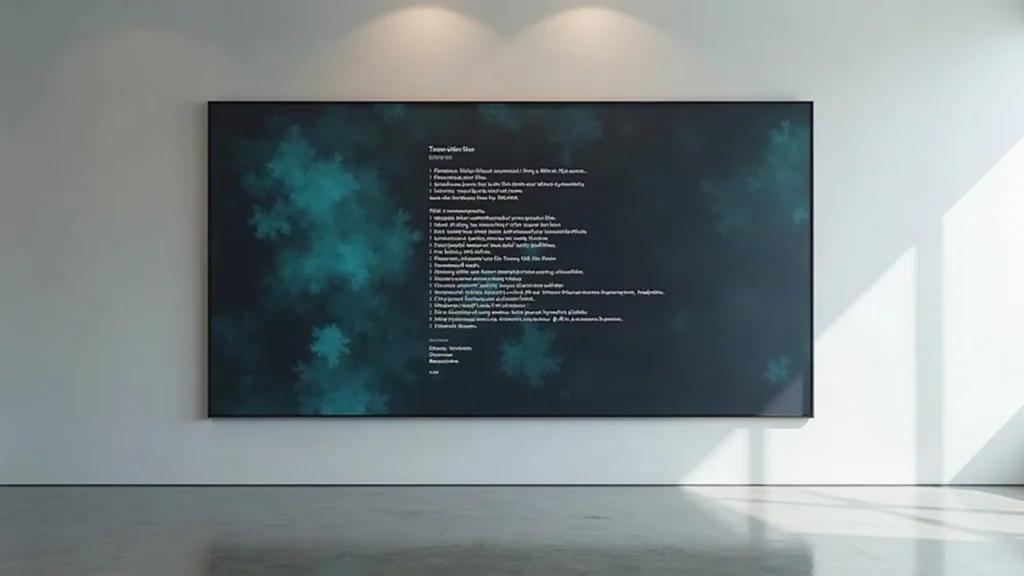
Traceforms has moved into CryptoSlam’s top NFT rankings shortly after its September 28 mint, joining a group of Ethereum collections whose artwork is stored or generated directly on-chain. The latest snapshot places four on-chain art projects, Traceforms, Credits, CryptoPunks and Argonauts, among the market’s most actively traded collections, adding weight to what CryptoSlam has characterized as an emerging “on-chain art season.” CryptoSlam’s live NFT rankings remain rolling snapshots and can change quickly as trading activity moves between collections.
Traceforms, created by 0xvesty, is an Ethereum-based experiment built around ASCII characters, light and abstract forms. The collection launched on September 28 with 7,777 pieces and uses blockchain-native data as part of the artwork itself. Its rapid entry into the trading rankings is notable because the project is competing for volume alongside established Ethereum collections rather than remaining confined to its initial mint activity. The distinction between mint demand and sustained secondary trading will become clearer as the collection moves further into price discovery.
Fully On-Chain Collections Take More Market Share
The broader grouping is significant because “fully on-chain” describes more than NFT ownership being recorded on Ethereum. In a fully on-chain collection, the artwork and metadata required to render it are stored directly on the blockchain rather than depending on a conventional server or an external storage reference. That gives the underlying work a different persistence model from NFTs whose token exists on Ethereum while their media remains elsewhere. OpenSea uses CryptoPunks as one of its examples of fully on-chain metadata and media.
Argonauts follows that model explicitly. OpenSea describes Alpha Centauri Kid’s collection as artwork that “lives directly onchain,” with the pieces preserved within Ethereum rather than pointing to externally hosted images. The collection has also generated substantial secondary turnover since its August launch. Its trading activity shows that blockchain-native storage is appearing not only in experimental releases but in collections capable of attracting meaningful liquidity.
Jack Butcher’s Credits provides another variation. Each Credit originates from an eligible $8 X Money payment, whose transaction identifier is hashed into 256 bits and converted into four visual grids. Statements created from Credits are drawn by the contract itself on-chain. The collection recently generated more than $2 million in 24-hour secondary sales, briefly leading Ethereum NFT trading and helping lift the network’s daily sales to $8.6 million. Credits’ recent Ethereum volume surge showed how quickly trading can concentrate around a newly active on-chain collection.
Ethereum Still Leads, but Volume Remains Concentrated
The wider NFT market was already strengthening before Traceforms entered the rankings. CryptoSlam data captured on September 26 showed global NFT sales of approximately $55.51 million over seven days, up 57.17%, with Ethereum contributing $30.33 million. CryptoPunks alone accounted for $8.24 million during that snapshot. Ethereum therefore remained the leading NFT network, but a meaningful portion of the increase came from a relatively small number of high-volume collections and transactions.
That concentration has appeared repeatedly. CryptoPunks has experienced large volume increases driven partly by whale purchases, while Compas has previously moved to the top of Ethereum NFT activity during another short-term rotation. Bitcoin-native TAP DMT-NAT has likewise produced concentrated marketplace sweeps without establishing a market-wide NFT trend.
Traceforms therefore adds evidence of a specific shift inside Ethereum NFT trading rather than proof of a generalized NFT boom. What stands out in the current rankings is that collectors are directing meaningful secondary-market activity toward several projects where the blockchain is part of the artwork’s storage or generation model itself. If that pattern persists after the initial Traceforms mint and Credits activity cools, the current “on-chain art season” may prove to be more than another short-lived reshuffling of CryptoSlam’s leaderboard.
Mia Thompson
I am Mia Thompson, a Blockchain Reporter specializing in Altcoins, and I am from Mexico. My day-to-day work consists of exploring the ecosystem beyond Bitcoin.
More from Mia Thompson →This article is for information only and is not investment advice. We report under our Editorial Policy; to flag an error, see our Corrections Policy.