Schwab’s Quiet Crypto Expansion Signals Brokerage Domination Over Native Platforms
Schwab expands crypto trading to SOL, AVAX, and LINK, challenging Coinbase and other exchanges for mainstream investors.

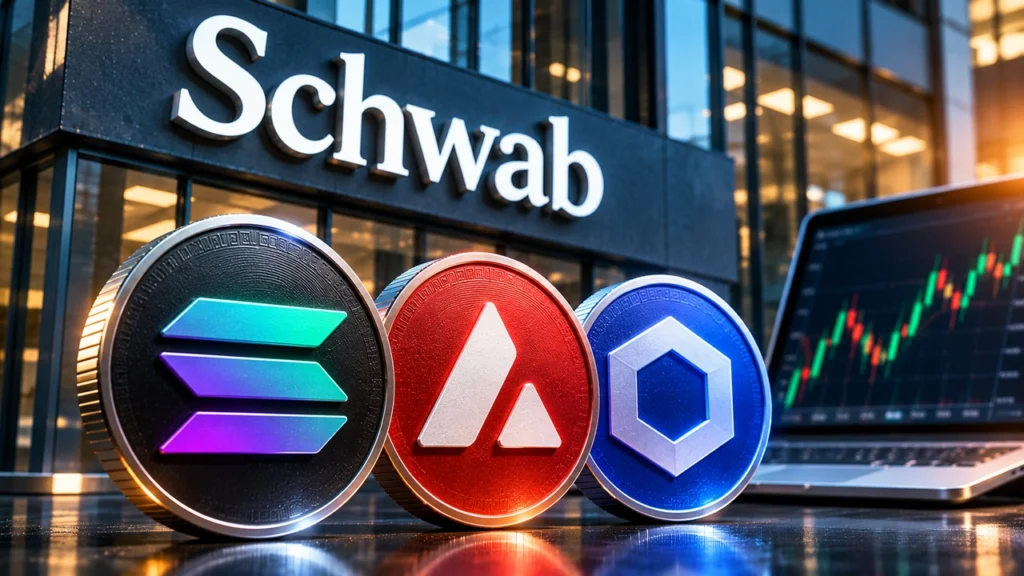
Charles Schwab has added Solana (SOL), Avalanche (AVAX), and Chainlink (LINK) to its cryptocurrency trading platform in the United States. The three assets join Bitcoin and Ethereum, with a 0.75% fee per trade.
While this may seem like another routine expansion of its services, it presents a problem for specialized exchanges: major traditional brokerages can now compete for their customers without requiring them to leave their existing accounts.
According to Schwab’s official announcement, users can trade all five cryptocurrencies through its website, mobile app, and thinkorswim platform. The company began offering limited access in May and opened the service to all eligible retail clients in October.
The expansion challenges one of the crypto industry’s original promises: that digital platforms would eventually displace traditional financial intermediaries. Schwab is demonstrating that those intermediaries can also offer cryptocurrencies while maintaining their relationships with customers.

Schwab Has an Advantage That Exchanges Cannot Easily Buy
Coinbase and other specialized platforms built their businesses by providing access to assets that conventional banks and brokerages avoided. For years, that distinction helped them attract users interested in Bitcoin and other tokens.
But Schwab already manages investments for millions of customers who use its services to buy stocks, funds, and other financial instruments. For these investors, adding cryptocurrencies to an account linked to their existing brokerage may be easier than registering with another platform.
The company does not need to convince these investors to switch financial providers. It can offer them new assets within an existing business relationship.
Its infrastructure also includes round-the-clock customer support, investment tools, and regulatory compliance processes developed for the U.S. market.
This does not guarantee that Schwab charges the lowest fees or offers better tools than crypto exchanges. Its selection is still limited to five cryptocurrencies, and the service is not available in New York or Louisiana.
However, for an investor who simply wants to buy and hold BTC, ETH, or SOL, access to hundreds of additional tokens may matter very little.
Institutional Adoption Could Benefit Traditional Financial Intermediaries More
The crypto industry often presents financial adoption as a victory for the companies that built its earliest platforms. But greater demand for cryptocurrencies does not necessarily mean that trading activity will end up on Coinbase.
If traditional brokerages succeed in capturing purchases from retail investors and financial advisors, they could retain a substantial share of trading fees and customer relationships.
Specialized exchanges would continue providing liquidity, infrastructure, and execution services. However, they could lose prominence as investors’ primary destination.
This distinction is crucial because controlling the customer relationship allows firms to distribute new products without having to compete for every transaction from scratch.
Schwab can also expand its offerings gradually. The company has already announced that it will add more digital assets based on demand and its selection criteria.
Each additional cryptocurrency removes another reason why certain investors need to use specialized platforms.
Crypto Exchanges Still Have Some Advantages
The competition is far from decided. Crypto platforms offer a range of assets, services, and features that traditional brokerages cannot yet match.
Coinbase, for example, provides tools for active traders and access to services connected to blockchain use. That market requires different capabilities from those needed to buy cryptocurrencies as conventional investments.
Furthermore, assets traded through Schwab Crypto are not protected by the FDIC or SIPC, even though the service is offered through an affiliated banking institution.
A familiar financial brand may inspire confidence, but it does not eliminate the risks associated with cryptocurrencies.
The real threat to exchanges lies in the segment of investors who are less interested in using blockchain networks directly. Someone seeking exposure to just five established assets may prefer their existing brokerage over a specialized platform.
Schwab still needs to demonstrate how much trading volume it can attract. But it already possesses something crypto companies have spent years and enormous resources trying to build: a customer base that trusts its infrastructure to manage investments.
If that advantage carries over into the crypto market, mass adoption could end up strengthening the very intermediaries Bitcoin was originally intended to make unnecessary.
Tyler Anderson
Hi there! I'm Tyler Anderson from Sweden, and I'm a Web3 Reporter. My main focus is exploring the evolution of Web3, from DAO governance to the real utility of decentralized protocols.
More from Tyler Anderson →This article is for information only and is not investment advice. We report under our Editorial Policy; to flag an error, see our Corrections Policy.