Does Binance’s Exit From Several European Markets Show That Global Exchanges Are Losing Their Place?
Binance's exit from European markets under MiCA raises concerns about competition, regulatory fragmentation, and the future of crypto trading.

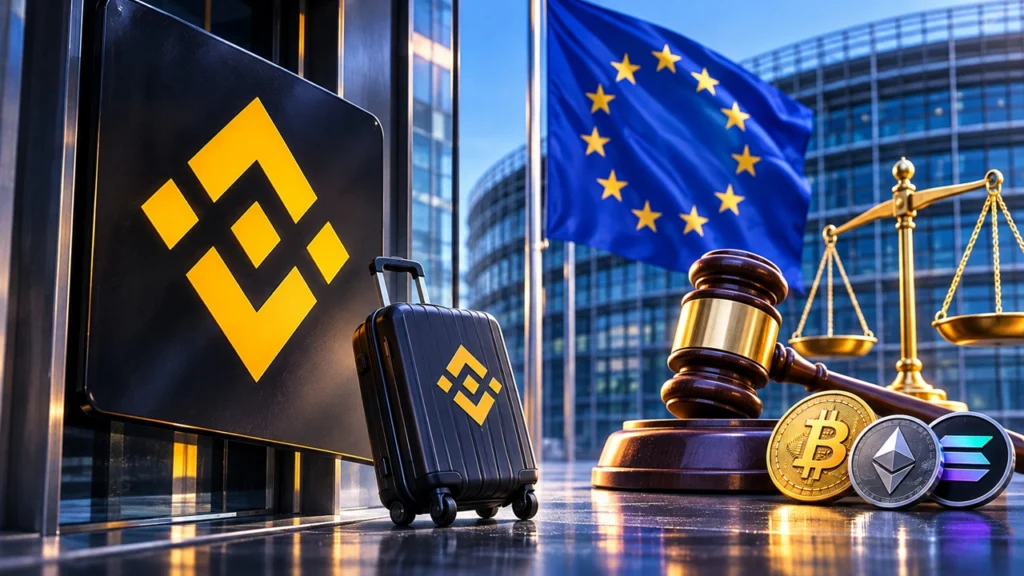
Binance will close the accounts of certain European users before the end of 2026 after failing to obtain authorization under the MiCA regulation. The measure affects customers in France and, according to notices received by users, also extends to countries such as Spain, Italy, and Poland.
The platform began restricting services after the European regulatory transition period ended. In France, affected users can no longer make deposits or trade, although they can still withdraw their assets.
According to notices sent to customers, affected accounts will be closed on December 31. Balances remaining from November 29 will be subject to a monthly fee of 0.025%, with a minimum charge of 10 USDC.
Binance withdrew its application for a MiCA license in Greece in June and announced that it would seek authorization in another member state. The issue is not that Europe has banned its operations, but that Binance still lacks the license required to continue providing certain services.
This situation raises a question for the industry: can exchanges maintain their international reach when each region requires different authorizations and operating structures?

MiCA Is Forcing Binance to Change Its European Business Model
For years, major cryptocurrency exchanges were able to serve users across numerous countries through international platforms and different legal entities.
MiCA establishes common requirements for cryptoasset service providers in the European Union. Companies must comply with obligations related to custody, customer protection, internal organization, and the prevention of market abuse.
The transition period ended on July 1. Since then, unauthorized providers have been required to discontinue affected services and arrange for their customers to exit.
The license also allows a company authorized in one member state to provide services in other European Union countries. Therefore, Binance does not need to obtain 27 different licenses to operate legally throughout the bloc.
The challenge is obtaining that authorization and adapting its operations to European requirements.
The European Securities and Markets Authority (ESMA) has called on unauthorized providers to allow customers to withdraw or transfer their assets without causing them unnecessary harm.
These obligations can improve user protection, particularly when a platform experiences financial or operational problems.
However, common regulation loses some of its immediate benefits when customers are forced to stop using services they previously relied on.
The cost of the transition also falls on users who need to transfer funds, open new accounts, and adjust their operations.
Fragmentation Could Reduce Competition Among Exchanges
Regulatory requirements come with costs that not every company can afford equally easily.
Exchanges need legal teams, internal controls, monitoring systems, and resources to maintain their authorizations.
Platforms with greater financial resources can adapt more easily, while smaller firms may struggle to compete.
Binance’s withdrawal from certain European services also does not guarantee that its customers will spread across numerous providers.
Some of that activity could shift to a handful of authorized exchanges capable of offering sufficient liquidity and a wide range of assets.
Less competition could mean higher costs and fewer options for users, although it would not necessarily lead to an immediate decline in overall liquidity.
There is also a risk that some traders will seek out platforms outside the European Union.
However, using foreign services does not automatically eliminate regulatory obligations or guarantee better security.
Fragmentation can make certain products harder to access and divide trading activity across regions with different rules.
For Binance, obtaining a European license would allow it to restore its operating capabilities under a common framework. Its current withdrawal does not prove that its international business model is unviable, but it does show that maintaining it requires very specific regulatory adjustments.

User Protection Should Not Come at the Expense of Choice
MiCA aims to establish rules that protect people using cryptocurrency services. Requiring custody controls and procedures for managing funds addresses genuine risks.
However, regulatory protection must also consider the consequences of forcing customers to move their assets.
The fees announced for affected Binance accounts illustrate a practical difficulty.
A minimum charge of 10 USDC can represent a substantial proportion of a small account. For a user holding 100 USDC, that amounts to 10% of their balance.
The ability to withdraw funds reduces the risk of losing access to them, but it does not eliminate the inconvenience or costs associated with migration.
It also matters that users can choose between regulated custodians, self-custody wallets, and other legally available services.
Regulation should not turn compliance into an advantage reserved for a small number of companies.
At the same time, allowing platforms to operate without meeting basic requirements would not protect customers either.
The challenge for European regulators is to apply the same rules without unnecessarily favoring established providers.
Binance is still seeking MiCA authorization and maintains that it remains committed to Europe. While that process continues, affected users will need to withdraw or transfer their assets within the deadlines communicated by the platform.
Tyler Anderson
Hi there! I'm Tyler Anderson from Sweden, and I'm a Web3 Reporter. My main focus is exploring the evolution of Web3, from DAO governance to the real utility of decentralized protocols.
More from Tyler Anderson →This article is for information only and is not investment advice. We report under our Editorial Policy; to flag an error, see our Corrections Policy.