Gensyn CEO Ben Fielding Featured on KBW AI Panel
Gensyn CEO Ben Fielding joins Korea Blockchain Week as decentralized AI shifts toward live infrastructure for compute coordination and verification.

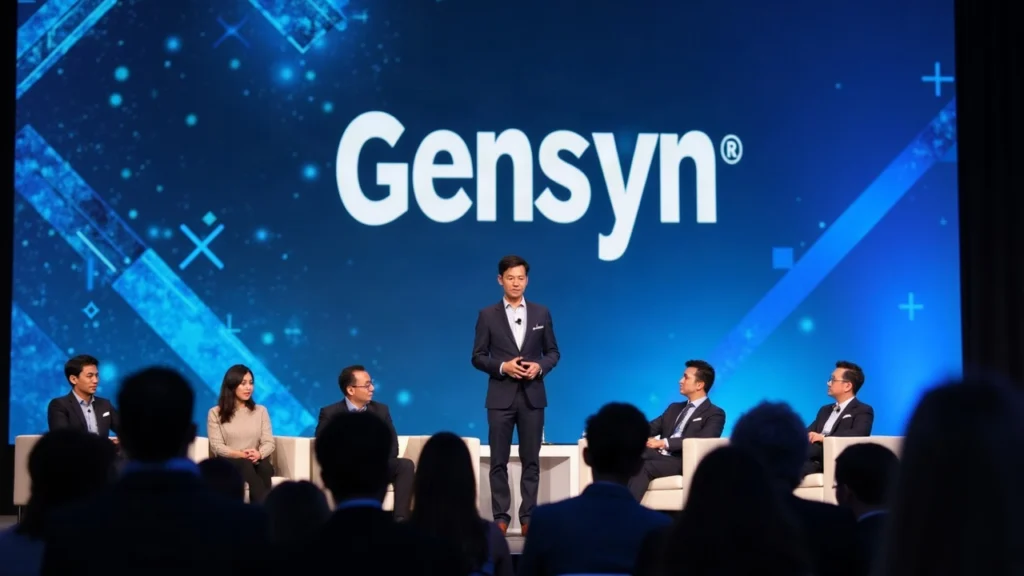
Gensyn co-founder and CEO Ben Fielding was featured on the October 1 program at Korea Blockchain Week in Seoul for a panel examining how artificial intelligence is evolving beyond model performance alone. Gensyn had confirmed Fielding’s participation ahead of the event, while the KBW program placed him on “Smarter Models, Harder Problems: Play, Training, and the Future of AI.” The session positioned decentralized AI infrastructure alongside the increasingly difficult technical questions surrounding how models are trained, coordinated and verified.
The appearance came during KBW’s main conference, held September 30 and October 1 at Walkerhill Hotels & Resorts, rather than a week-long main summit. A wider schedule of partner and side events surrounded the conference across Seoul. Fielding’s participation also came after Gensyn had moved beyond a testnet-only phase, making the discussion more directly connected to infrastructure the project is already operating rather than a purely prospective decentralized-compute model.
Thursday October 1: Korea Blockchain Week
Ben will also be taking part in the panel "Smarter Models, Harder Problems: Play, Training, and the Future of AI"
Registration and details at the KBW website: https://t.co/xE4JgnpEw6
— gensyn (@gensynai) September 28, 2026
Gensyn Moves Decentralized AI Into Mainnet
Gensyn describes its network as a decentralized protocol designed to coordinate machine-learning execution, verification and communication across heterogeneous computing resources. Its blockchain layer is an EVM-compatible OP Stack rollup handling identity, payments, staking and reputation for human and machine participants. The blockchain does not perform large AI workloads itself; it provides coordination and settlement around computation that can occur off-chain, a distinction that avoids treating conventional on-chain execution as a substitute for GPU-intensive machine learning.
That architecture reflects a broader infrastructure challenge across crypto and AI. Other systems are similarly experimenting with moving specialized AI execution closer to blockchain-native infrastructure, while decentralized GPU networks are developing dynamic compute provisioning for autonomous AI agents. The common problem is not simply finding computing power, but coordinating who supplies it, how workloads are executed and how other participants can verify the resulting computation.
Gensyn’s production focus has also changed over time. Its earlier RL Swarm environment demonstrated collaborative reinforcement learning across distributed nodes, but Gensyn’s current dashboard says no official swarms are running. Meanwhile, Delphi is live on Gensyn Mainnet as an information-market application where AI participates in market settlement and agentic trading workflows. Gensyn therefore has live blockchain infrastructure, but that should not be interpreted as evidence that every part of its decentralized-training vision is currently operating at production scale.
Verification Becomes a Core AI Infrastructure Problem
Verification remains one of Gensyn’s central technical themes. Its Verde research introduced a mechanism designed to resolve disagreements over machine-learning computation without requiring an entire training task to be repeated, while newer Gensyn infrastructure emphasizes cryptographic evidence that computations ran as specified. The objective is to make externally executed AI work auditable without assuming that the machine performing the computation must automatically be trusted.
That concern extends well beyond Gensyn. Infrastructure projects are pursuing different trust models, including hardware-attested private AI inference and blockchain systems that expose specialized verification mechanisms directly to applications. Those approaches make different tradeoffs between hardware trust, cryptographic proofs, reproducibility and operational cost. As AI workloads become increasingly distributed, the question shifts from whether computation can happen off-chain to how its execution can be proven reliably enough for another machine or smart contract to act on the result.
Fielding’s KBW appearance fits that transition. The intersection of AI and crypto is increasingly moving beyond broad claims about pooling unused GPUs toward concrete systems for execution, verification, coordination and machine-to-machine settlement. Gensyn’s current stack shows that transition in practice, while the gap between deployed infrastructure and sustained decentralized compute usage remains an important boundary when assessing how mature the sector has actually become.
Tyler Anderson
Hi there! I'm Tyler Anderson from Sweden, and I'm a Web3 Reporter. My main focus is exploring the evolution of Web3, from DAO governance to the real utility of decentralized protocols.
More from Tyler Anderson →This article is for information only and is not investment advice. We report under our Editorial Policy; to flag an error, see our Corrections Policy.