MetaMask Launches AI Agent Wallet With Built-In Security Controls
MetaMask launches Agent Wallet, bringing self-custodial controls and security checks to AI-driven DeFi activity.

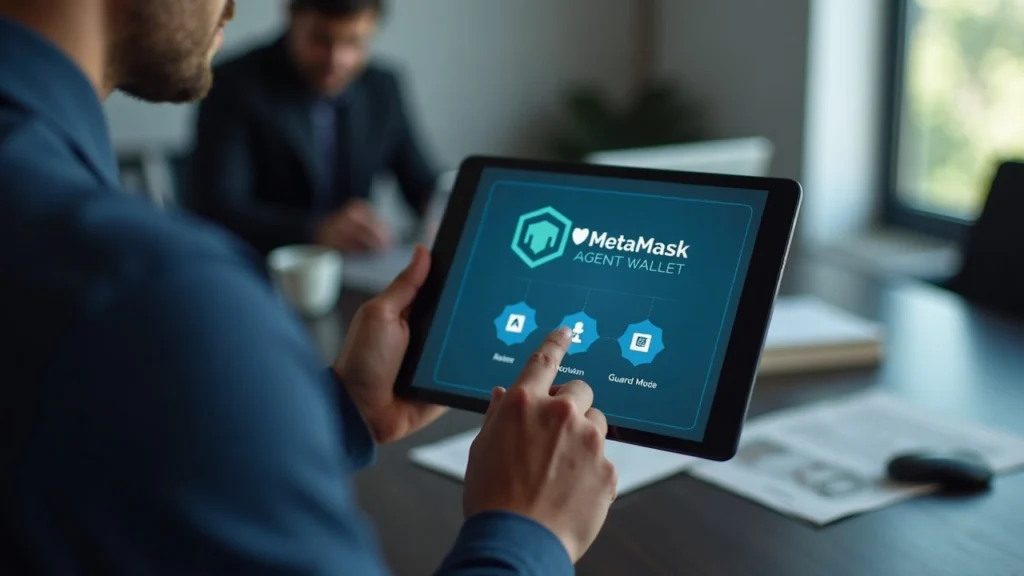
MetaMask has launched Agent Wallet, a self-custodial infrastructure product built to let autonomous AI agents interact with decentralized finance protocols under user-defined security limits. The product entered an Early Access Program on June 8, with a wider public rollout planned for later this summer, making AI-controlled on-chain activity a formal product category inside MetaMask’s wallet stack.
The launch addresses one of the clearest risks in agent-based crypto trading: blind-signing. Instead of giving an AI agent direct access to private keys, Agent Wallet routes automated actions through a controlled environment where users define permissions, spending limits and escalation rules, preserving human oversight over machine-speed execution.
MetaMask Targets the Blind-Signing Problem
Agent Wallet uses a command-line interface designed to connect with AI agent frameworks including OpenAI Codex, Anthropic’s Claude Code and Hermes Agent. The wallet supports Ethereum Virtual Machine-compatible chains such as Ethereum, Arbitrum, Base and Polygon, as well as the Hyperliquid network, giving developers a broad execution surface for AI-assisted DeFi workflows.
Unlike traditional wallets, the product applies mandatory security checks to every transaction. Automated actions pass through MetaMask’s existing security stack, including transaction simulation, Blockaid-powered threat scanning and Clear Signing, so users can review human-readable transaction details before execution risk becomes irreversible.
MetaMask has built the product around two operational settings. Guard Mode, the default option, lets users set daily spending limits and protocol allowlists, while any transaction that exceeds those limits or receives a suspicious risk flag requires manual two-factor authentication before it can proceed, creating a permissioned operating model for autonomous agents.
Beast Mode gives agents more room to operate independently, but it does not remove the security layer entirely. Even in the less restrictive setting, MetaMask still requires manual approval for transactions identified as potentially malicious by its scanning infrastructure, keeping a final human approval gate for high-risk activity.
The wallet also ties approved transactions into MetaMask’s Transaction Protection program. Transactions deemed safe by the system are covered for up to $10,000 in monthly protection against specific losses, adding a risk-mitigation layer for users experimenting with automated DeFi execution.
Private Keys Stay Inside Isolated Infrastructure
Agent Wallet uses Cubist’s trusted execution environment technology to secure the signing process. The hardware-isolated enclave is designed to keep private keys protected during transaction signing, preventing both MetaMask and its parent company, Consensys, from accessing user key material, which reinforces self-custody as the product’s central security premise.
That architecture places Agent Wallet in the broader industry push toward clearer signing standards. By pairing isolated key management with Clear Signing, MetaMask is trying to reduce the risk that users or agents approve opaque transaction prompts, a recurring source of losses in crypto and a critical weakness for automated wallet activity.
“If the first generation of trading agents normalizes giving away your keys, we’ll be rebuilding the custodial mistakes crypto spent a decade escaping,” said Zhen Yu Tong, Senior Director of Product at MetaMask, in the announcement. The statement captures the strategic tension between automation and self-custody that Agent Wallet is trying to resolve.
MetaMask’s move also lands as crypto infrastructure providers invest more heavily in AI-native trading systems. Aptos recently committed $50 million to autonomous agent trading and storage systems, while Ethereum co-founder Vitalik Buterin has previously noted that AI-assisted verification could reduce the attack surface for smart contracts, giving Agent Wallet a timely market context beyond MetaMask’s own ecosystem.
For now, access remains limited. Agent Wallet is restricted to roughly 200 users in the Early Access Program, with developers and users able to apply through MetaMask’s official website before the broader release later this season, leaving the first production test concentrated among a small group of early participants.
The immediate takeaway is that MetaMask is not simply adding another wallet feature. It is building a controlled execution layer for AI agents in DeFi, where autonomy is possible but bounded by transaction scanning, spending rules, allowlists and human approval triggers, making secure agent-driven trading the core product thesis.
Colin Harris
I'm Colin Harris, L1s Analyst and Web3 Reporter for the United States. My day-to-day involves diving into the fundamental layers of the ecosystem, specializing in Layer 1 (L1s) networks.
More from Colin Harris →This article is for information only and is not investment advice. We report under our Editorial Policy; to flag an error, see our Corrections Policy.