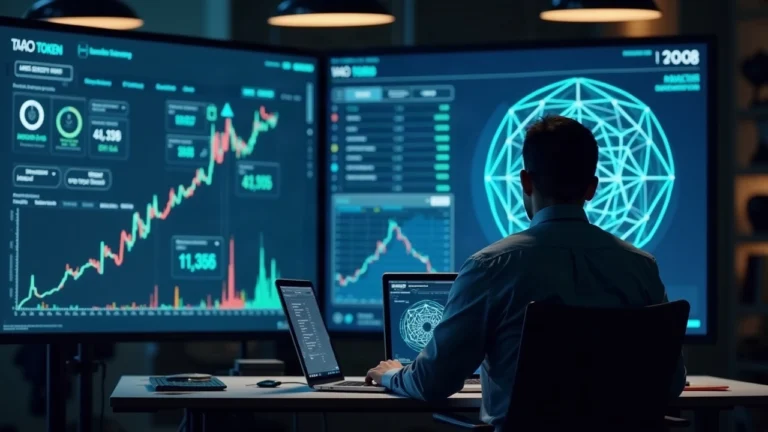
Fractal analysis flags 40% downside for Bittensor’s TAO

Bittensor’s TAO token has surged about 160% in a little over a month, but the latest technical setup is now flashing warning signs that the rally may be approaching a vulnerable stage. Analysis points to a convergence of momentum and trend signals that, taken together, raise the probability of a sharp correction after the recent advance.
The most important trigger in that analysis is the formation of a so-called golden cross, with the 20-day exponential moving average pushing above the 200-day EMA. That crossover would normally be seen as a bullish development, but in TAO’s case the historical pattern has often been followed by steep drawdowns rather than durable upside.
📈 Bittensor has erupted with a price surge of +140% in 6 weeks, and +105% since March 8th alone. The now #26 market cap has been at the center of the fast-growing AI narrative, with capital rotating toward decentralized machine learning projects as one of the market’s hottest… pic.twitter.com/JKIYHStzB2
— Santiment Intelligence (@SantimentData) March 25, 2026
Fractal signals point to a possible reversal
The fractal review argues that this is not an isolated reading but part of a recurring pattern in TAO’s price behavior. In three earlier instances, similar golden-cross formations were followed within five to six weeks by declines ranging from roughly 32.5% to 45.5%, producing an average correction of about 40%. If that historical tendency repeats, the analysis suggests TAO could slide toward the $200 area by early May.
At the same time, the pattern is not entirely one-directional. Those same historical windows also included an average upside extension of about 21.3%, which implies TAO could still push toward the $420 region before any broader reversal fully takes hold. That leaves the token in a technically unstable position where short-term continuation and medium-term weakness can coexist.
Market conditions described alongside the analysis fit that interpretation. TAO has climbed back above $300, with trading reported in the $335 to $345 range, but recent 24-hour declines of 6% to 8% suggest that profit-taking may already be starting to test the strength of the move. In that sense, the recent rally has not yet broken down, but it is no longer moving without visible friction.
Volatility also raises operational pressure across the network
The implications extend beyond chart analysis. For validators, node operators and participants whose budgets and staking exposure are closely tied to TAO, a correction of the size outlined in the report would quickly translate into tighter operating conditions and weaker token-denominated incentives. A large drawdown would reduce the effective value of rewards and narrow the margin available to cover infrastructure costs.
Shorter-term volatility can also create practical stress before any full correction develops. A brief rally toward higher levels could improve liquidity and fee generation for a limited period, but a fast reversal after that would increase the pressure on participants managing bandwidth, storage and staking thresholds against a rapidly changing token price. That makes the next several weeks especially important from both a market and operations standpoint.
The analysis does not present the bearish scenario as inevitable. It frames the setup as probabilistic, not deterministic, meaning the key risk is not certainty of a drop but the growing concentration of signals that have previously preceded one. For teams exposed to TAO, the most prudent approach is likely to focus on monitoring the moving averages, RSI behavior and liquidity conditions while preparing for a period of elevated tail risk.
Derek Vaughn
Hi! I'm Derek Vaughn, a Market Research Specialist based in Nigeria. I analyze crypto markets from a global perspective, trying to understand what's behind price movements and liquidity trends. I've been covering the digital ecosystem for several years, and my style is based on rigorous, data-driven research.
More from Derek Vaughn →This article is for information only and is not investment advice. We report under our Editorial Policy; to flag an error, see our Corrections Policy.