Starcloud says it will mine Bitcoin from low‑Earth orbit with dedicated satellite rig
Starcloud plans to launch Starcloud-2, a Bitcoin-mining satellite, testing whether space-based solar power and cooling can make orbital mining viable.

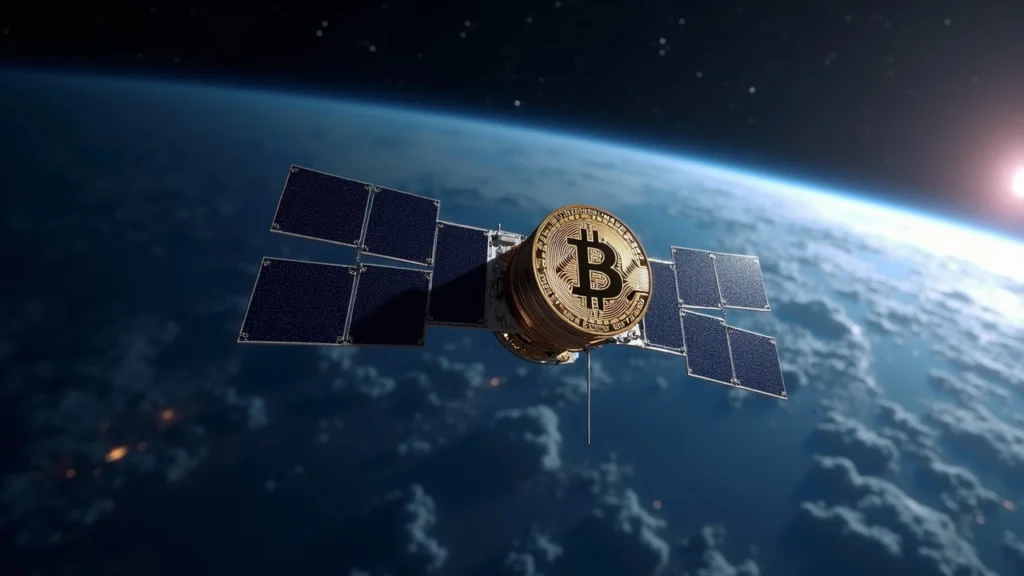
Starcloud, an Nvidia-backed orbital data-center startup, says it wants to push Bitcoin mining beyond Earth by launching Starcloud-2, a dedicated mining satellite planned for low-Earth orbit by late 2026. The idea is ambitious and deliberately unconventional: use near-continuous solar exposure and the cold vacuum of space to rethink the cost structure of mining. The concept sounds futuristic, but the real question is whether the physics can overcome the economics.
According to company statements and industry coverage, Starcloud sees two main advantages in orbital mining. First, space offers access to persistent solar energy without the grid constraints, land costs, or local permitting issues that shape terrestrial mining operations. Second, the low-pressure environment could make thermal management more efficient, at least in theory, by reducing the infrastructure normally required to cool dense compute systems. In Starcloud’s pitch, space is not just a novelty location for mining, but a potential way to redesign energy and cooling assumptions from the ground up.
The cat is out of the bag: @Starcloud_-2 will be the first to mine 𝗕𝗶𝘁𝗰𝗼𝗶𝗻 in space.
This will be a massive industry in itself. Right now, bitcoin mining consumes about 20 GW of power continuously. It makes no sense to do this on Earth, and in the end state, all of this… pic.twitter.com/tmfr8rxGOL
— Philip Johnston (@PhilipJohnston) March 7, 2026
Starcloud is using an earlier in-orbit test as proof of credibility
The company is not starting entirely from zero. Reports say Starcloud previously launched Starcloud-1, a satellite that carried an Nvidia H100 GPU and successfully ran a small AI training task in orbit. That earlier test is now being used as a proof point for the broader vision behind Starcloud-2. By showing that high-performance compute can function in orbit at all, the company is trying to make the leap to Bitcoin mining sound less speculative and more like the next engineering step.
Starcloud has also argued that Bitcoin ASICs may be more practical to launch than top-tier AI chips because they are cheaper per kilogram and purpose-built for a single task. That matters because in space, every kilogram has to justify itself economically. The company’s case depends on the idea that specialized mining hardware could make orbital deployment more financially rational than launching more expensive, general-purpose compute.
The theory is compelling, but the obstacles are brutal
Even if the core logic is sound, the barriers are enormous. Launching and maintaining a mining satellite is not remotely comparable to plugging machines into a warehouse on Earth. Upfront capital costs are high, replacement cycles are slow, and every maintenance problem becomes an aerospace problem. The biggest challenge is not proving that mining in space is possible, but proving that it can stay competitive while hardware on Earth keeps getting cheaper, faster, and easier to replace.
That last point may be the hardest one to solve. Bitcoin mining hardware evolves quickly, and obsolescence is already a major issue for ground-based operators. In orbit, that problem becomes much more expensive. Once hardware is deployed, upgrading it is difficult, slow, and potentially uneconomic unless the company can justify replacement launches or some form of robotic servicing. A mining machine that becomes outdated on Earth is an inconvenience; a mining machine that becomes outdated in orbit is a capital problem with no easy fix.
There are also harsh environmental realities. Space may be cold, but thermal management is not automatically simple. The company’s own earlier experience reportedly included a GPU failure linked to overheating, which undercuts the idea that orbit solves cooling by itself. Electronics must also survive radiation exposure and operate reliably in an environment where repair is extremely limited. The vacuum of space can help with some cost assumptions, but it also introduces failure modes that most mining operators never have to think about.
Commercial success will depend on far more than engineering
Even if Starcloud solves the hardware problem, profitability still depends on variables the company cannot control. Bitcoin price, mining difficulty, and ASIC efficiency trends will shape whether the project ever produces an attractive return. That means Starcloud is not just betting on aerospace engineering; it is also betting on the future economics of Bitcoin mining itself.
The significance of Starcloud-2 is less about immediate impact on the Bitcoin network and more about whether it can prove that a high-capex, low-marginal-energy-cost mining model is viable. If the company succeeds, it could open a new conversation about where hash rate can live and how mining can source energy. If it fails, it will reinforce the idea that some theoretical efficiencies are simply too expensive to operationalize.
Starcloud’s claims and the third-party reports around them have not been independently verified here, and that caveat matters because the project is still at the stage where execution risk dominates everything. Until Starcloud-2 is actually in orbit and operating over time, the venture remains a fascinating experiment rather than a proven business model. Still, it is one worth watching, because it tests whether the boundaries of Bitcoin mining are technical, economic, or simply geographical.
Colin Harris
I'm Colin Harris, L1s Analyst and Web3 Reporter for the United States. My day-to-day involves diving into the fundamental layers of the ecosystem, specializing in Layer 1 (L1s) networks.
More from Colin Harris →This article is for information only and is not investment advice. We report under our Editorial Policy; to flag an error, see our Corrections Policy.