Poland Halts MiCA Implementation After President Raises Freedom Concerns
Poland’s veto of its MiCA bill halts domestic licensing, raising legal uncertainty and pushing crypto firms toward EU jurisdictions.

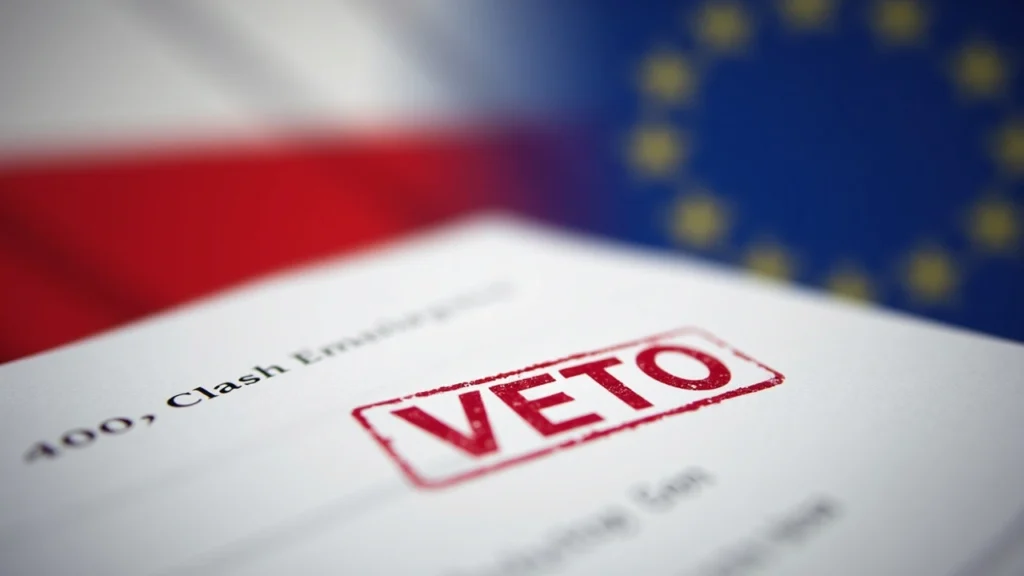
Poland’s President Karol Nawrocki vetoed Bill 1424 on December 1, 2025, blocking Poland’s national implementation of the EU MiCA framework and warning it threatened “the freedoms of Poles, their property, and the stability of the state.” The decision immediately halted the law’s progress and left domestic crypto firms without a national path to MiCA authorization, creating legal and commercial uncertainty.
A veto driven by concerns over speech, complexity and market fairness
The president’s objections focused on three major risks he associated with Bill 1424. First, a proposed “single-click” power allowing the Polish Financial Supervision Authority (KNF) to block crypto-related websites was criticized as an opaque mechanism that could endanger free speech. Second, the bill’s more than 100 pages were deemed unnecessarily complex compared with shorter regional implementations. Third, planned supervisory fees were viewed as prohibitively high and likely to disadvantage startups in favor of large foreign firms and banks. Presidential spokesperson Rafał Leśkiewicz labeled the draft a “legal dud,” and Nawrocki framed the veto as a defense of market freedoms.
MiCA — the EU’s Markets in Crypto-Assets framework — seeks to harmonize crypto-asset rules across member states, and national laws like Bill 1424 are the gateway for firms to obtain mandatory EU-level authorization.
The veto produced a regulatory vacuum: without a national implementation, Polish companies cannot apply for MiCA authorization and therefore cannot operate under EU-wide permissions. The government warned that this would isolate domestic firms and push them to relocate to EU jurisdictions with established MiCA pathways, carrying risks of lost tax revenue and diminished domestic innovation. Finance Minister Andrzej Domański described the aftermath as “chaos and a vacuum,” accusing the president of giving “scammers a free pass.”
Political reactions split sharply. Opposition and pro-crypto voices hailed the veto as a victory for market freedom, with Sławomir Mentzen arguing the bill would have “destroyed the Polish cryptocurrency market.” Meanwhile, the ruling coalition condemned the move and noted that overriding the veto requires a three-fifths Sejm majority, a threshold difficult to reach.
Operational disruptions were immediate: the veto froze the licensing route Polish authorities had planned, forcing firms to wait for a revised bill or seek authorization abroad. This delay carries into a period of legal uncertainty ahead of MiCA’s full EU application, which the government has repeatedly tied to December 2026.
The veto preserves a constitutional check on expansive digital regulation but places Poland’s crypto sector in regulatory limbo with clear commercial and fiscal downsides.
Mia Thompson
I am Mia Thompson, a Blockchain Reporter specializing in Altcoins, and I am from Mexico. My day-to-day work consists of exploring the ecosystem beyond Bitcoin.
More from Mia Thompson →This article is for information only and is not investment advice. We report under our Editorial Policy; to flag an error, see our Corrections Policy.